Forecasting Accountability Across Sales and RevOps
Clear role boundaries and accurate commission data are the missing pieces.

Forecasting accountability does not fail because people are careless or dishonest. It fails because ownership of the forecast is split across three functions, Sales, RevOps, and Finance, and the lines between what each one owns are rarely written down clearly enough to hold up once a quarter gets contested. Sales leadership owns the commit number and carries it upward. RevOps owns the forecasting process itself: the data quality behind it and the method used to produce it. Finance checks the assumptions behind the forecast and lines it up against the budget. Each of these jobs is distinct on paper, but in practice the trouble starts at the handoffs between them, the points where one function's output becomes another function's input. When those boundaries blur, when Sales starts redefining its own CRM stages, or Finance starts quietly adjusting RevOps numbers without agreeing on a shared method first, bias creeps into the number and trust between the groups starts to erode. None of this is a motivation problem. It is what happens when a system has three owners and no one has written down where one owner's job ends and the next one's begins.
Role accountabilities and their boundaries
A workable forecast depends on three accountabilities that do not overlap: Sales owns the judgment call, RevOps owns the infrastructure, and Finance owns the validation. Few organizations ever put this in writing, and that is why the boundaries erode under pressure.
Sales leaders are accountable for the commit number and for the kind of judgment that no dataset can replace: whether a specific deal is actually going to close this quarter, slip to the next, or grow beyond its current size. That judgment is the job. It should not get overridden by a process change unless there's real evidence behind the override.
RevOps is accountable for the process and for the data the process runs on. That includes stage definitions, probability weightings, CRM hygiene standards, the choice of forecasting method, and the reporting layer that makes the resulting numbers something people can actually trust.
Finance is accountable for taking the forecast and using it, for budgets, for hiring plans, for what gets reported to the board or to investors. Finance needs a number it can stand behind in front of those audiences, and that means Finance needs to trust the process that produced it, not just the number itself.
Forecast accuracy works as a credibility metric for RevOps specifically. Consistently inaccurate forecasts erode leadership's trust in the numbers RevOps produces, leading Finance to apply its own informal corrections on top of the forecast. That one move, Finance quietly haircutting RevOps numbers because the methodology isn't trusted, is the clearest sign that accountability has already broken down. The same signal appears on the Sales side when managers start adjusting stage data to protect their own forecast rather than to reflect what's actually happening with the deal.
How CRM data quality corrupts the forecast
Role clarity only helps if the data running through those roles can be trusted, and for most organizations, the CRM data feeding the forecast can't be. The problems are not subtle or hard to find. Close dates go unset. Opportunity amounts sit stale for weeks. Deals get parked at the wrong stage. Activity logging has gaps that hide whether a rep is actually working a deal or has quietly let it go cold. These are basic fields and basic habits, and at most organizations they are routinely broken.
A common failure pattern occurs at the end of every month: deals get rushed across the line, and the metadata behind them gets corrected after the fact. Someone in operations fixes an error here, a rep tries to shift credit there, and each of these small corrections adds noise to the stage-progression data that the forecasting model is built on. Activity data matters just as much as stage data in this picture. A deal can show healthy, steady progress through the pipeline stages while the rep hasn't touched it in two weeks, and in that case the deal is probably stalled no matter what the stage field claims. When activity logging depends on reps remembering to do it by hand, that signal disappears from the forecast model.
Weighted pipeline models, time-series models, deal-level machine learning models, these only produce better forecasts than each other once the input data clears a basic bar for completeness and consistency. Below that bar, they're all guessing from the same bad inputs. A workable floor looks like this: every opportunity carries a mandatory close date, amount, stage, and forecast category; automated checks run weekly to catch what's missing; and managers run a monthly audit of each rep's pipeline. Anything missing those fields is effectively invisible to the forecast, no matter how sophisticated the model sitting on top of it is.
The most often ignored piece of the accountability chain is commission data
Commission data sits right at the point where CRM accuracy, rep behavior, and forecast reliability all meet, and yet most organizations file it under payroll administration instead of treating it as part of the trust infrastructure the forecast depends on. That's a mistake with real consequences, not just a filing error.
When reps don't trust how their commission gets calculated, they respond in a predictable way: they build their own spreadsheets, check every deal by hand, and spend selling time auditing their own paychecks instead of working the pipeline they're supposed to be building. That shadow accounting habit does damage well beyond the time it costs. A rep who doesn't trust the system has less reason to keep the CRM accurate, because the CRM no longer feels like the record that determines their pay. It feels like a system they have to work around.
Trust problems like this behave as lagging indicators. By the time commission errors raise a retention problem or a visible dip in morale, the damage to rep engagement and to CRM discipline has already been building for months. Unclear commission structures are linked to 35% annual turnover among sales reps, a rate meaningfully higher than the broader workforce sees, and every rep who leaves takes quota coverage, pipeline continuity, and the accumulated judgment that makes forecast calls reliable with them.
Bad commission data creates rep distrust. Rep distrust drives shadow accounting, shadow accounting leaves the CRM neglected, a neglected CRM produces bad forecast data, bad forecast data erodes Finance's trust, and Finance responds with shadow corrections of its own. At the end of that loop, no one actually owns the number anymore. Every function named in the first two sections of this piece, Sales, RevOps, Finance, has its accountability undermined by a commission process most organizations never thought to connect to forecasting.
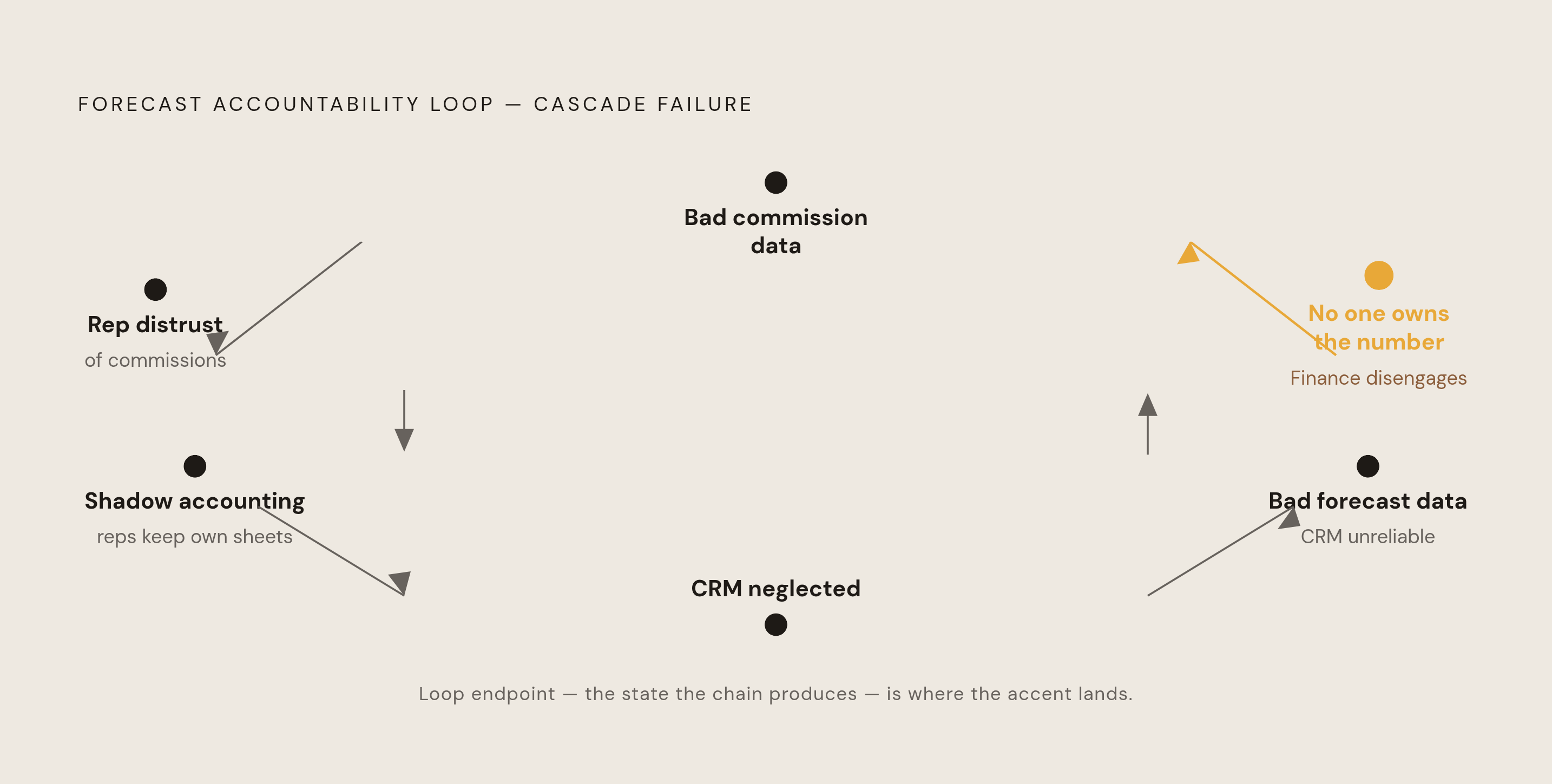
How accurate, auditable commission data changes the accountability chain
Fix commission data and the loop runs in reverse. When commission numbers are accurate, visible, and auditable, reps stop maintaining shadow spreadsheets, CRM data quality improves because reps have a reason to trust the system again, forecasting models get better inputs, and Finance ends up with numbers it can actually rely on.
Real-time, deal-level earnings visibility is what breaks the shadow accounting habit directly. Once a rep can see how a closed deal turns into a specific commission amount, there's no reason left to keep a side spreadsheet or to double-check every CRM entry out of suspicion. Locked pay periods with a logged approval trail give Finance something it can point to for compliance and for financial close, and that same record settles rep disputes on the spot instead of letting them escalate into a drawn-out argument.
RevOps gains something concrete here too. When commission rules live in a structured system instead of a spreadsheet, a plan change, a revised accelerator, a new SPIF, a clawback rule, gets applied the same way across every deal without someone re-running calculations by hand. That consistency removes a whole category of error that would otherwise work its way upstream into the forecast.
Finance gains something just as concrete. Commission expense turns into a predictable line item that doesn't need manual reconciliation every month, and the hours RevOps and Finance currently spend running commission by hand, which across many organizations eats up a substantial portion of a working month, can go toward analysis instead. There's a second-order benefit as well: when changing a plan is cheap, organizations actually change plans when they need to. Teams running commission by hand tend to leave a broken accelerator in place mid-cycle because recalculating everything by hand is too costly to justify, even when everyone agrees the plan isn't working. Once that operational cost drops, plans can evolve to match how the business is actually running.
Why spreadsheets fail as commission infrastructure
Spreadsheets do a lot of things well, but commission infrastructure asks for an audit trail, real access controls, live visibility, and the ability to change a plan without a manual rebuild, and a spreadsheet can't deliver any of those at the scale the accountability chain actually needs.
Start with the audit trail. A spreadsheet has no way to lock a pay period. Any formula in it can be edited after the fact by anyone with access. Finance can't treat a spreadsheet commission run as a record it can defend in an audit. The number is only as reliable as whoever last opened the file.
Visibility is almost as hard to deliver. A spreadsheet can be set up to give each rep read-only access to their own numbers, but getting there takes real manual effort, separate sheets per rep, IMPORTRANGE formulas stitched together, and careful permission settings that break easily and are a burden to maintain as the team grows. Even built well, that setup still doesn't give you the audit controls or the automatic syncing that a purpose-built commission system provides as a baseline.
The operational cost compounds every month. Manual commission runs mean someone pulls the data, someone reconciles the formulas, managers sign off, and someone handles whatever disputes come up, and all of that adds up to a real burden that a structured tool would handle in minutes instead. Commission data is compensation data, so it carries the same sensitivity as payroll. It needs encryption in transit and at rest, access scoped to the right people, and an audit trail by design, none of which a spreadsheet provides on its own.
The integration gap is the deeper issue. When a deal closes in the CRM, a spreadsheet process needs a human to pull the deal data out, apply the right plan rules, and type the result in somewhere else. Every one of those manual steps is a place where an error or a delay can creep in; a connected system removes the whole chain by pulling deal amount, close date, product type, and assigned rep automatically, the moment the deal closes.
Requirements for structured commission software to close the accountability gap
Closing the accountability gap this piece has traced from Sales through RevOps through Finance down to commission data requires a platform that does four things well: it connects directly to where the deal data already lives, it applies plan logic in a way that can be traced back to its source, it gives every stakeholder the visibility their role actually needs, and it treats commission data with the same security a payroll system would require.
The first piece is CRM-native data import. The platform needs to connect directly to systems like Salesforce or HubSpot and pull deal data automatically, so that when a deal closes, the deal amount, close date, product type, and assigned rep all flow in without anyone typing them by hand. A vendor that calls its integration native while still requiring custom field mapping or manual handling of exceptions has left the underlying data quality broken.
The second piece is traceable plan logic. Tiered rates, accelerators, SPIFs, and clawbacks need to exist as codified rules in the system rather than as formulas buried in a spreadsheet, so that every dollar of commission can be traced back to the specific rule that produced it. A rep, a manager, or a finance auditor should be able to follow that logic deal by deal without needing to ask someone to explain it.
The third piece is role-appropriate visibility. Reps need to see their own deal-level earnings and quota progress in real time. Managers need attainment distribution and a read on how well the plan itself is working. Finance needs locked, approved pay period records it can carry straight into payroll. None of these groups should have to ask someone else for a spreadsheet extract just to see data that's already theirs.
The fourth piece is locked pay periods with a logged chain of approvals, which gives Finance the audit trail it needs for compliance and gives reps protection against numbers getting changed after the fact. Tied to all of this is security that matches what the data actually is: commission data is compensation data, so it needs encryption in transit and at rest, strict org-level separation so one customer's data is never exposed to another, and a clear policy against using customer data to train models or build new product features. Buyers evaluating a commission platform against this standard should look for native CRM integration with no manual exception handling, a deal-level audit trail, rep-scoped real-time visibility, locked pay periods, encryption at rest and in transit, org-scoped tenancy, a no-training policy on customer data, and pricing built around the number of active compensation plans rather than per seat, since per-seat pricing quietly punishes a company for giving its own reps the visibility this entire argument depends on.