Quota Setting Ownership in RevOps vs Sales Leadership
RevOps and sales leadership must jointly own quota setting to make targets credible.

Quota setting fails in most sales organizations because no single function owns it from end to end, and the handoffs between functions are where the damage happens. Three failure modes repeat across companies regardless of size or industry. In the first, Finance sets a top-line number and sales leadership divides it by region without reconciling the assumptions behind it, so the quota looks reasonable in a boardroom and falls apart the moment a rep tries to hit it in the field. In the second, sales leadership sets numbers through internal negotiation, and the resulting targets get sandbagged or inflated depending on who had more leverage in the room. In the third, the whole exercise happens once a year and never again, so the plan can't adjust when a territory's potential shifts mid-year, a competitor pulls out of a market, or a rep leaves and their accounts get reassigned. SalesGlobe's State of Sales Compensation research found that many organizations still set quotas largely by rolling historical performance forward rather than evaluating current territory potential and market conditions, which is the most common version of the first failure mode: a number that was defensible last year gets treated as defensible this year, with no real test of whether it still is.
What RevOps contributes to quota setting
RevOps supplies the analytical backbone that makes a quota number defensible. That means it pulls territory potential modeling, historical attainment data from the CRM, pipeline coverage ratios, and the kind of cross-functional data reconciliation that neither Finance nor sales leadership can do well on its own. The inputs RevOps works from include individual rep attainment history and team-level performance trends, win rates by segment, average deal sizes, sales cycle lengths, and the account-level potential that gets missed entirely when a quota is just last year's number with a percentage tacked on. RevOps also sits in the best position to reconcile Finance's top-down revenue target against the bottom-up potential sitting in individual accounts, because it has access to both data sets and the tools to model them against each other. What RevOps cannot supply, no matter how good its models are, is the commercial read on what a market will actually bear. It can't tell you how a competitor's recent pricing move will shift demand in a specific region, or what a realistic stretch target looks like for a team that just lost its two best reps. That judgment sits with the people who are in the market every day, not with the people building the spreadsheet.
Where sales leadership's instincts lead quota-setting astray
Sales leadership brings exactly the commercial judgment that a data model can't produce on its own: a read on what the market can bear, which territories are undervalued or overloaded relative to their assigned numbers, how competitive shifts will move demand, and what counts as a realistic but ambitious target for a given segment. Frontline managers add a layer that neither RevOps nor senior sales leadership can replace on its own. They know which reps are still ramping, which territories have open headcount that nobody has backfilled, and where the pipeline assumptions baked into the planning deck don't match what's actually sitting in the CRM. That ground-level knowledge is often the difference between a quota that's ambitious and one that's simply unworkable. The trouble starts when sales leadership's input isn't bounded by any analytical discipline. Negotiated-down quotas produce attainment numbers that look strong on a dashboard but don't reflect real performance and don't hold up when Finance tries to build a revenue plan on top of them. If top-line pressure inflates quotas with no territory-level validation behind them, the attainment crisis that compensation research repeatedly documents is the result. Either error compounds as it moves downstream: sandbagged quotas overstate what a rep's capacity actually is, and inflated ones destroy commission trust and push good reps out the door. The 2026 sales compensation trends research puts a fine point on this. It found that a strong accelerator provides little motivation to a seller whose quota is disconnected from the potential of the assigned territory, and that an unusually favorable territory can generate excessive payouts that have nothing to do with exceptional performance. Both outcomes trace back to the same root cause: quota-setting judgment that was never checked against anything.
How the RevOps–sales leadership alignment gap breaks quotas
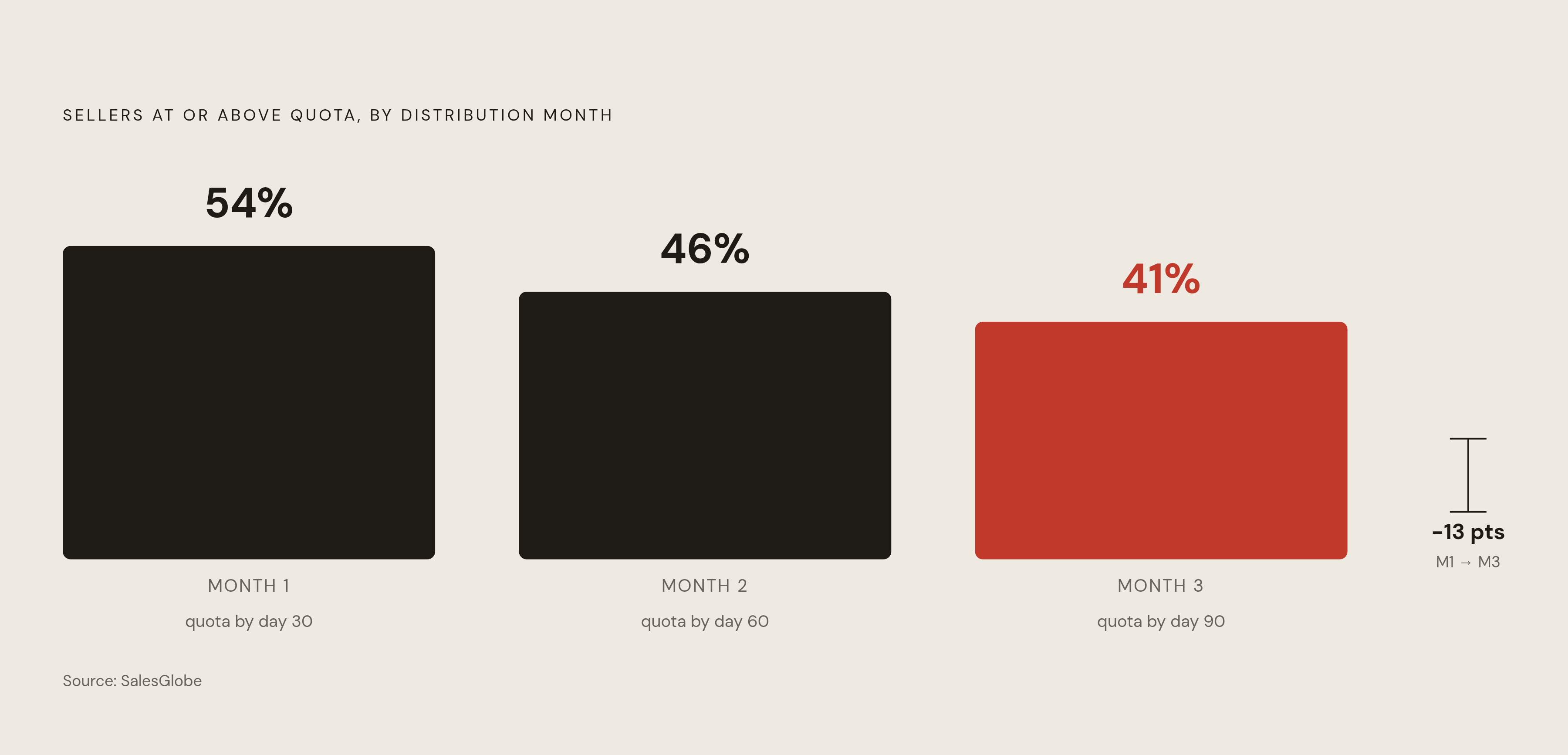
RevOps and sales leadership don't fail here because they disagree with each other; they routinely plan from different assumptions and never sit down to reconcile them, so the gap between those assumptions doesn't appear in the plan until it's already live and reps are already working against it. Fullcast's 2026 framework lays out the mechanics: Finance sets a top-line revenue target, sales leadership divides that target across regions, marketing commits to a separate set of pipeline numbers in its own deck, and nobody at any point reconciles the three. The gaps between them only become visible once execution is underway, and by then it's too late to fix the plan without disrupting the quarter. Three specific consequences follow from this pattern. Quotas end up assuming pipeline volumes that marketing was never actually going to deliver, because the quota was derived mathematically from a revenue target built on demand assumptions nobody tested. If growth rates get applied as a flat percentage lift across every territory, that ignores how widely territory potential varies, so some numbers turn out punitive and others trivially easy to hit. And plans arrive late, because reconciliation happens at the last minute if it happens at all, which costs the field selling time exactly when early-quarter momentum matters most. The data backs up how much that timing costs. SalesGlobe's research found that organizations distributing quotas by the end of Month 1 reported an average of 54% of sellers at or above quota, a number that dropped to 46% by the end of Month 2 and 41% by the end of Month 3. That decline is the direct operational cost of late reconciliation between the teams that were supposed to be planning together from the start.
A working model for shared quota-setting ownership that produces credible targets
Quota setting works when it runs as a single integrated process with clear boundaries around who owns what, rather than four separate functions handing a document back and forth. RevOps owns the data foundation and the process mechanics. Sales leadership owns commercial validation. Finance owns budget-level constraint and the reasonableness check on the final numbers. Frontline managers supply the territory-level ground truth that keeps the whole model honest. The 2026 sales compensation trends research frames this as the standard that disciplined organizations already operate by: quota setting should be an integrated process involving Finance, Sales, RevOps, territory planning, and frontline leadership together, not a spreadsheet exercise that gets built after the financial plan is already locked. In practice, that process follows a specific sequence. It starts with territory and account potential modeling before any number gets assigned to anyone, with RevOps building that model from CRM data, historical win rates, and market sizing. Next, you reconcile the bottom-up account potential against the top-down revenue target before either side treats its number as fixed, so Finance and RevOps work from the same underlying data. Sales leadership and frontline managers come in after that to validate the territory-level numbers before anything gets published, and their job at that stage is to flag where the model doesn't match field reality, not to renegotiate the company-wide target. Before the plan goes out, it should run through scenario modeling, testing what happens if headcount in a region lags or if pipeline falls short by some defined margin, so the plan has already been stress-tested against the conditions most likely to break it. And the plan should go out before the fiscal year begins, because the research consistently ties earlier distribution to stronger attainment. One more piece matters as much as the sequence itself: fairness has to be visible to the field, not just confirmed internally among planners. When a rep can see why their number is what it is, whether that's territory potential, historical conversion rates, or their own ramp status, the quota stops feeling arbitrary and starts functioning the way it's supposed to.
Quota credibility as the upstream condition for commissions and rep trust
A quota that reps don't believe in poisons the entire commission system built on top of it. When a target feels arbitrary or disconnected from what the territory can actually produce, reps stop treating the commission plan as a real motivator, so they start building their own shadow calculations on the side, and managers end up defending a number instead of coaching performance. Commission accuracy depends entirely on quota accuracy upstream of it. A commission calculation can be mathematically flawless and still produce a payout that's commercially wrong: the quota underneath it was never right to begin with, and reps notice that even when the math checks out. The 2026 compensation trends research makes this mechanism explicit: a well-designed commission formula cannot fix a fundamentally flawed target, and a strong accelerator gives a seller little reason to push harder when the quota underneath it was never connected to what the territory could realistically produce. There's a trust chain running from the quota through the commission calculation to how a rep actually behaves. A credible quota, one the rep understands and believes is achievable with real effort, makes the commission plan legible, because the rep can draw a straight line from effort to reward. A credible commission calculation, one the rep can trace down to the individual deal, reinforces that the quota was worth working toward. When both hold, the plan does what it's supposed to do and drives behavior. When either one breaks, reps disengage or start looking elsewhere. Fullcast's 2026 Benchmarks Report-informed material documents how this compounds over time: unrealistic quotas push reps to disengage or leave, pull managers into defending numbers instead of coaching, and erode the credibility of forecasts in front of the board, a cycle that repeats for as long as the same broken quota process keeps producing the same broken outcomes. Audit trails and locked pay periods matter because of this chain. When a quota changes mid-year without anyone documenting it, there's no way to reconstruct what a rep was actually being measured against at any given point, and that gap creates both compensation disputes and real compliance exposure.
What commission software must handle under distributed quota-setting ownership
When quota setting runs through Finance, RevOps, sales leadership, and frontline managers all at once, the commission system sitting downstream has to reflect that distributed input accurately and traceably, without anyone manually reconciling different versions of the same plan. Commission plans need to be built from deal data that flows directly out of the CRM rather than re-entered by hand, since manual entry is how version drift creeps back into a process the quota work was designed to eliminate. The commission rules themselves need to support the full range of quota-linked structures a real sales org actually uses: tiered rates, accelerators tied to attainment thresholds, SPIFs, clawbacks, and ramp adjustments for reps who are still new. Pay periods need to be lockable, with approvals logged, so there's an auditable record of what quota and what commission rules applied to a given rep at a given point in time. Reps need to see deal-level earnings statements rather than a single summary payout number, so they can check that the quota and the commission calculation match what they actually experienced selling in the field. And commission data needs to be handled as compensation data: encrypted, scoped to the organization, governed by role-based access, not passed around in spreadsheets that end up circulating well past the people who should have access to them. Quota Queue builds toward this standard directly, with plans assembled from CRM data, pay periods that lock with logged approvals, and rep-facing statements that show earnings at the deal level as a single opaque number would not. Its pricing model is based on the number of active compensation plans rather than per-seat fees, which reflects how quota-setting ownership is spread across more people than a typical seat-based license accounts for. When damage from a sandbagged or inflated quota reaches the commission stage, a rep on an undervalued territory ends up with commission upside that was capped before they ever worked a single deal, while a rep on an overloaded territory can clear bonus thresholds that have nothing to do with how well they actually sold. Platforms like Quota Queue can make that misalignment visible in the commission statement itself, but no commission tool fixes a broken quota. That fix belongs to the quota-setting process described above. The practical test for any commission platform operating under this kind of distributed ownership is simple: can Finance and Sales work from the same underlying data source without manually reconciling a spreadsheet the quota team owns against a separate one the commissions team owns? If the answer is no, the platform hasn't actually solved alignment. It has just rebuilt it somewhere else.