RevOps Tech Stack Audit Process for Growing Companies
Commission management software bridges your CRM and payroll to expose hidden integration failures.

A RevOps tech stack audit follows four phases, which are inventory, integration mapping, redundancy elimination, and gap filling. For mid-market RevOps and Finance teams, commission software belongs in that process when spreadsheets stand between CRM deal data and the compensation calculations and payroll that use it. Commission management is a reliable stress test of the stack because it exposes integration failures, weak financial controls, and gaps in rep visibility at the same time.
Why growing companies keep adding tools without adding clarity
Growing B2B revenue teams buy tools for one function at a time, with a good reason for each. A CRM comes first, followed by a sequencer, enrichment, analytics, and a BI layer as new needs appear. Each purchase solves a problem at hand but may not fit with the tools already in place, fragmenting operations.
That fragmentation begins as a process gap. Adding software to a broken process can make its flaws spread faster, while records fall out of date in different ways in systems that are not connected. Teams then stop trusting the data and stop acting on it. The cost appears as lost selling time, inaccurate forecasts, and quota misses. This is a solvable architectural problem, and the audit addresses it.
What a RevOps tech stack audit actually is, and what it is not
A RevOps tech stack audit maps every tool to a revenue function, measures real usage and data output quality, and identifies manual handoffs or duplicate entry between systems. Its endpoint is a consolidation roadmap that identifies what should remain, what should go, and which missing capabilities need investment. It is not simply a procurement exercise. Nor is success defined by the number of subscriptions cancelled.
The CRM anchors the audit because other revenue tools depend on its records and workflow context. Data quality runs a close second, since a well-configured CRM can still misroute activity and produce inaccurate forecasts from stale records. A startup using a CRM, a data provider, and native reporting needs the same distinction between an authoritative record and an unreliable handoff, even if its roadmap is much shorter.
Phase one: building the real inventory, not the assumed one
The first phase establishes what the company actually uses. Get every SaaS line item from Finance and check it against what is in IT’s SSO directory, browser extensions, and the shared password vault. No single list provides the full picture. The inventory should include subscriptions that people buy on their own and tools that separate teams use, even when they are outside the approved stack.
Shadow IT is a structural discovery. These tools often reveal unmet needs in the core stack and can also introduce consequential data conflicts because integration with it was outside their design. Assign each tool to one revenue function, namely prospecting and enrichment, outreach and engagement, pipeline and CRM, or analytics and forecasting. Leave anything that cannot be assigned visibly unclassified for later review. At this stage, the task is enumeration, including older tools maintained by habit long after the conditions that justified them have changed.
Phase two: mapping integrations and finding where data actually breaks
With the inventory complete, map which systems write to the CRM, which read from it, and which operate on separate data islands. Mark every export, transformation, and re-entry step needed to keep them current. These handoffs introduce both delay and error. For each tool, establish who uses it weekly, what decision it drives, and what breaks if it is removed. Unclear answers make a tool a consolidation candidate.
The map makes dependencies visible across revenue workflows. A meeting logged without its full context reaching the CRM can leave a sequence firing at the wrong time, a forecast inaccurate, and a rep working with incomplete information. When commission data is kept apart from CRM events, calculations rely on manual imports, which affect how accurate Finance can be and how much reps trust the results. The audit should mark that bridge as an integration gap before judging the software on either side.
Phase three: identifying redundancies and making the elimination case
The integration map provides the evidence for consolidation. Overlap often comes from sales and marketing buying separate sequencers, more than one enrichment source meeting the same need, or dashboards that use different field definitions and show conflicting values from the same CRM data. Category overlap alone is not decisive. Two tools may perform different tasks yet still create conflict when their outputs feed the same decision and neither is authoritative.
For leadership, prepare a three-column view showing the tool, annual cost, and recommendation. Each proposal to remove a tool should refer to the map and show which other tool covers its function and which conflicting output or needless handoff would go away. Low adoption strengthens the case when users have abandoned a tool because its data is unreliable. Cost reduction follows the architectural decision. The goal is fewer tools and lower spend without sacrificing needed functions, leaving each retained system authoritative for its role and connected to a single source of truth.
Phase four: filling the gaps the audit reveals
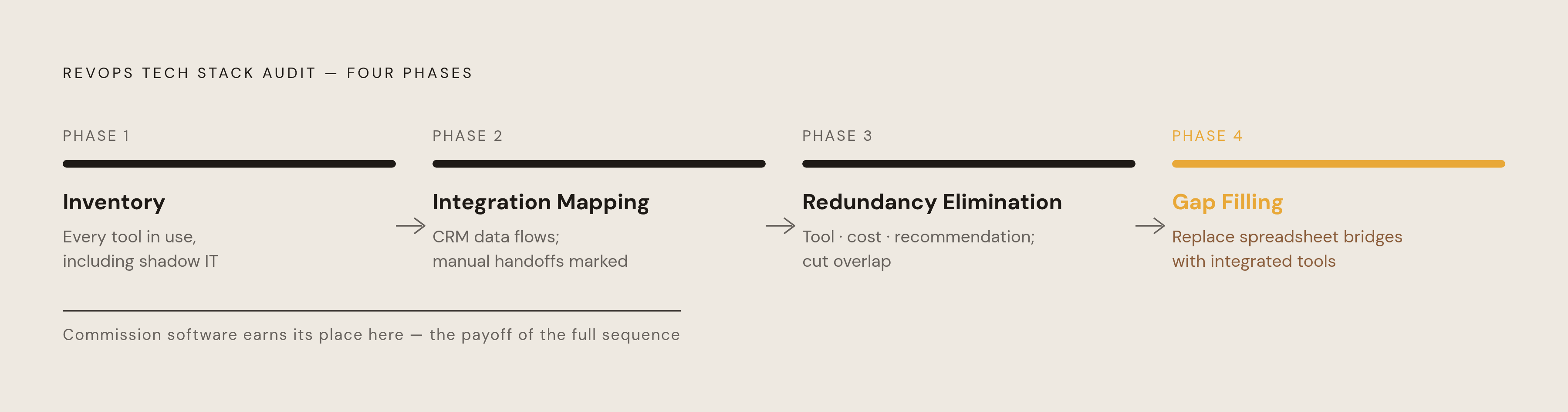
Removing overlap can expose functions the stack never reliably performed. A redundancy means multiple tools compete to do a job, while a gap means no tool does it dependably. Manual work can conceal that distinction for years. A spreadsheet that bridges systems or performs an otherwise unsupported calculation may have become essential without ever becoming a governed part of the architecture.
The consolidation roadmap should fill those gaps with purpose-built tools that meet three requirements. The tool should integrate with the existing CRM without a rip-and-replace, produce output other systems can consume without manual transformation, and meet the organization’s data governance standards. A new subscription is justified by closing the gap. Commission management is a concrete example when a spreadsheet serves as the bridge between CRM deal data and payroll. That bridge lacks direct integration, requires output transformation, and provides no dependable audit trail, making it a capability gap rather than merely an inconvenient calculation method.
Why commission management is the most diagnostic gap in the audit
Commission management combines CRM data, finance workflows, and sales compensation in one process. It therefore tests more than whether two applications exchange records. It also tests whether rules are governed and whether the resulting payout can be explained. Separating commission data from CRM events introduces latency and error before the person running the spreadsheet makes any mistake.
Spreadsheet-dependent workflows then expose three recurring failure modes. Formula drift allows an overwritten cell or a typo in a nested calculation to miscalculate payouts silently, sometimes until a later dispute reveals it. Version conflicts occur when operations managers work from separate copies and merge changes by hand, which can bring back errors that were already fixed. An absent audit trail leaves no dependable record of the rules, inputs, or manual adjustments behind a payout.
As territories, quotas, and payout tiers grow more complex, manual reconciliation becomes structurally inadequate. The audit should test whether CRM data can reach commission calculation and payroll export without a spreadsheet bridge.
How spreadsheet-based commission creates compounding problems across sales and finance
For reps, opaque calculations encourage shadow accounting through private commission trackers. For Finance, the same opacity creates a need to reconstruct calculations before approving or defending payouts. Both responses take time that stays hidden in the original workflow. Reps divert attention from selling, while Finance absorbs dispute handling and adjustment work without a clean record of how the number was produced.
The consequences extend beyond a wrong payment. Underpayments can prompt escalation and weaken trust, while overpayments to a top performer may be absorbed. A rep’s confidence in the process is distinct from the amount paid and affects engagement, disputes, and retention. Finance has a parallel requirement for audit trails, locked historical statements, and approval workflows, with ASC 606 capitalization and amortization adding compliance exposure to manual commission tracking.
In the audit, warning signs include runs that take multiple days, dependence on one analyst, rising adjustments, and manual accrual or GL export work. Payout timing can also diverge from financial recognition. Payout triggers should reflect broader revenue recognition practices, rather than leaving sales and Finance to reconcile that difference informally.
What purpose-built commission software fixes in the stack architecture
Purpose-built commission software takes the place of the spreadsheet bridge with a direct CRM connection, a calculation engine that is locked and can be audited, and output that is ready for payroll. The CRM remains the system of record for deal data and workflow context. Software cannot compensate for unreliable source records. Its job in the stack is to apply compensation rules to that data without the need for exports or changes to existing CRM workflows.
The calculation layer must support the actual plan structures, including tiered rates, accelerators, SPIFs, clawbacks, multi-role credit allocation, and territory-based rules. A manual workaround for any of these relocates the original gap. Locked pay periods and logged approvals must make each payout traceable to source deal data and the applicable plan version. Giving reps access to their earnings, quota progress, and deal-level statements meets their separate need to see those details.
Security belongs in the same design decision. Compensation data needs encryption in transit and at rest, org-scoped tenancy, and a strict policy that bars training models on customer compensation data. Those protections treat commission records with the same care as payroll data.
How should mid-market RevOps and Finance teams evaluate commission software?
For mid-market RevOps and Finance teams that have outgrown spreadsheets, the strongest fit is commission software that closes the mapped CRM-to-payroll gap without creating another silo. Evaluation should begin with direct CRM data import, because a product requiring manual exports preserves the failure the audit identified. Payroll-compatible output completes that integration test. Feature breadth is secondary if people still have to transform data between systems.
Plan flexibility is the next criterion. The platform must work with the organization’s compensation structures and let teams change them without help from engineering every time. Finance should then assess whether locked pay periods, logged approvals, and exportable statements produce a traceable record of the inputs and plan version behind each payout. Security review should apply payroll-level standards, including encryption, org-scoped data tenancy, audit trails, and an explicit model-training policy.
Per-seat pricing increases cost with headcount and can create pressure to return to spreadsheets as complexity grows. With per-compensation-plan pricing, cost grows with how complex the plans are. The comparison should therefore reflect the initial subscription cost and how the organization expects its sales team and compensation plans to change.
Running the audit as a repeatable process, not a one-time cleanup
The audit should run annually as part of budget planning, with a six-month cycle for high-growth teams whose headcount and plan changes introduce new dependencies. A significant tool addition, sales organization restructure, territory redesign, or compensation plan overhaul warrants a review of affected data flows before the next scheduled cycle.
The inventory makes later passes less demanding. The first audit must discover the true tool count, while subsequent reviews can account for changes against an existing baseline. Going through the four phases again catches subscriptions no one uses, overlap that has returned, and integration drift before they build on each other. When a monthly commission run starts to need manual steps, brings more disputes, or has delays that last days, it gives an early warning that the map needs a review.
The practical health check is an observable workflow. CRM data goes straight to the calculation engine, the plan rules that have been configured are locked, and payouts go through logged approval to export without manual transformation. Reps can see their earnings, and Finance can trace the result.