Scaling Your Sales Team Without Scaling Your Commission Software Bill
Choose plan-based pricing to decouple headcount growth from your software costs.
Per-plan commission software pricing charges for compensation plan structures rather than individual users, so adding reps to an existing licensed plan does not increase the software bill. To grow a sales team without growing its commission software bill, a company must choose the right pricing architecture as well as negotiate a lower seat price. That choice must also account for integration work, administration, and the controls needed to produce accurate, auditable payouts.
Why commission software pricing deserves as much scrutiny as commission plan design
A new sales hire can bring in revenue before that revenue starts to come in. Under per-seat commission software pricing, the software bill also goes up as soon as that hire joins. Hiring therefore changes more than the payroll budget. It increases the cost of administering compensation, compressing the potential margin benefit of growth before that benefit materializes. The software contract becomes part of the economics of every hiring decision.
Sales leaders give considerable attention to accelerators, split structures, and ramp periods because those choices shape how a compensation plan performs as the organization expands. The pricing model for the software that runs the plan needs just as much attention. Commissions are already one of a company’s largest variable cost lines, and a headcount-linked software charge adds another expense that rises with the team. This is a structural business decision.
How per-seat pricing turns headcount growth into a compounding software cost
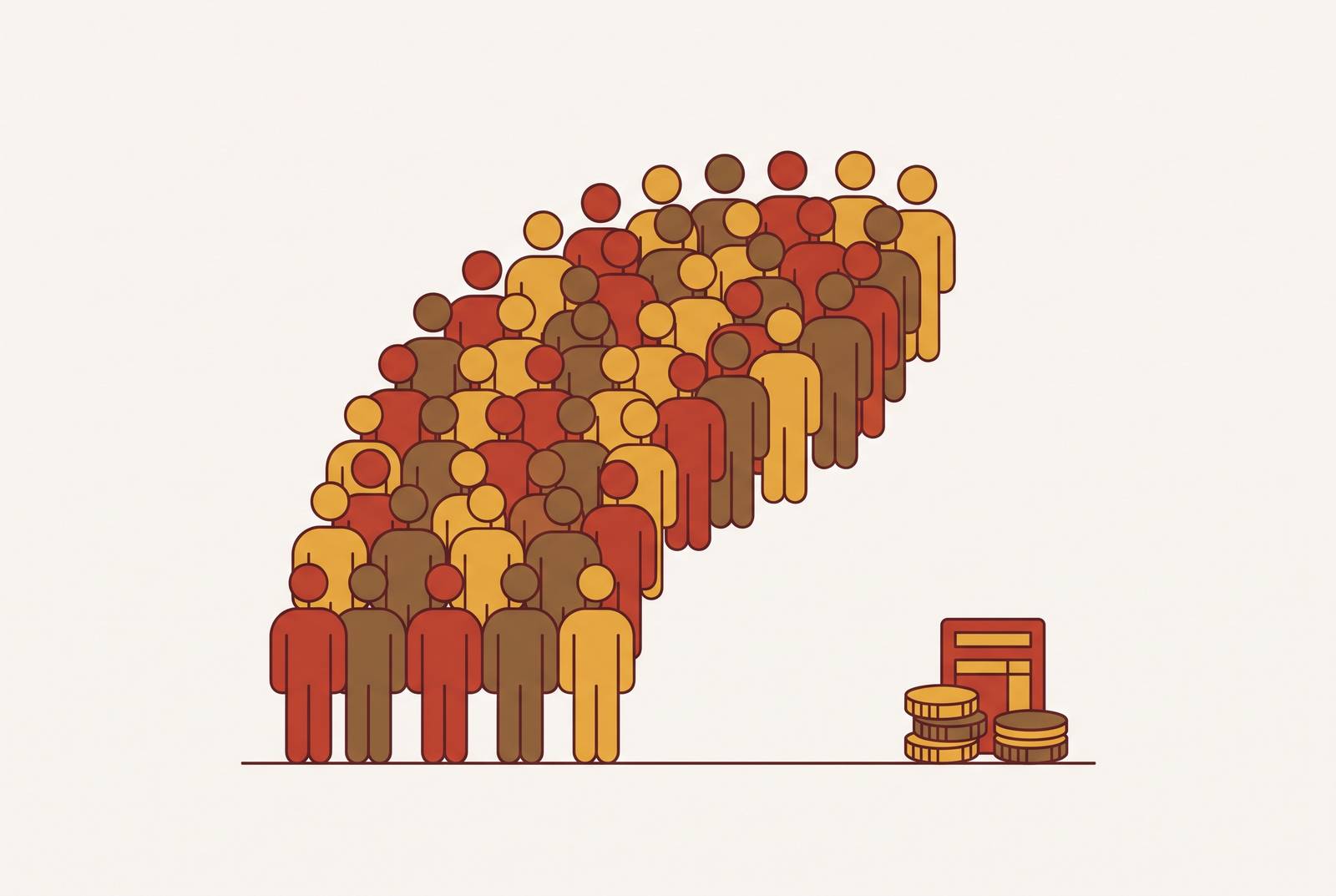
Per-seat pricing has a fixed charge for each user. Under a flat per-seat rate, every additional rep adds the same increment to the software bill, a linear relationship with no diminishing rate as the organization grows. Its cumulative effect comes from repeated hiring, because the charge grows in lockstep with headcount and has no natural upper bound.
With commission software, there is also little room to cut that cost by giving fewer people access. Every commissionable rep must be represented in the system for the payout run to be complete. Seats are not discretionary in that operating model. Limiting them cuts into the job the company bought the software to do, beyond cutting access to a tool some employees rarely use.
When the team is small, the cost can seem easy to manage because the first bill covers only the people already on it. A hiring wave changes that calculation without requiring any change to the compensation plans themselves. For a team planning a sales ramp, the lesson is to model this expense as a separate line in the hiring forecast, rather than discovering its effect when the software invoice arrives.
How do you avoid paying more for commission software every time you hire a new rep?
Per-plan commission software pricing changes the unit being purchased from a user to a compensation plan structure. An enterprise AE plan, an SMB AE plan, an SDR plan, and an overlay plan represent different structures that the platform administers. More reps can join an existing licensed structure without another user charge.
This architecture can separate headcount growth from software cost because companies generally add reps faster than they redesign compensation structures. A larger team may continue to use the same set of plans. In that case, the software bill stays flat. If growth introduces new plan structures, however, the plan-based charge can increase, so per-plan pricing should not be mistaken for an unconditional fixed-price promise.
A platform-fee-plus-per-seat hybrid has a different cost curve. Its fixed fee spreads across a larger team as headcount rises, reducing the effective cost per rep, while the seat-based component continues to grow. A buyer seeking commission tracking software that does not charge per user or per seat therefore needs to check whether the pricing is plan-based or a hybrid that still charges for headcount.
These differences make pricing architecture an early evaluation question. Before comparing features, buyers should model each approach at their expected headcount in 12, 24, and 36 months, including expected changes to plan structures. That comparison shows which expense grows with people, which grows with compensation design, and which combines both.
The hidden cost that makes pricing model choice more urgent: what spreadsheets actually cost at scale
Staying in spreadsheets avoids a commission software invoice, but it does not remove the cost of administering commissions. It moves that cost into manual work, error correction, payout disputes, and lost selling time. Those costs are harder to see than the cost of a subscription. They also grow with the same expansion that makes per-seat pricing unattractive, so postponing software does not preserve a cost-free operating model.
Formula drift is one source of that burden. A user can overwrite a formula cell, leaving a buried error to miscalculate payouts across a rep cohort until someone disputes a number, sometimes pay periods later. Separate file copies create a different problem. When operations managers work from different versions, merging them by hand can reintroduce errors that had already been corrected, without establishing a dependable source of truth.
The absence of a calculation history makes disputes harder to resolve. Without a record of the rules applied, the input data, and manual adjustments, proving a payout correct requires a reconstruction. The financial consequences are asymmetric. Overpayments can be difficult to recover, with procedures varying by state and repayment demands creating attrition risk, while underpayments can lead a rep to scrutinize every subsequent payslip.
That response often takes the form of shadow accounting, where reps maintain private commission spreadsheets because they do not trust the official number. Time spent reverse-engineering payouts is time not spent closing deals. This is both a trust problem and a productivity leak, distinct from the broader audit and accounting weaknesses of spreadsheet administration. The pricing decision is therefore a choice between two cost structures, one visible in software charges and the other distributed across operational labor, errors, and disputes.
What grows with your team besides headcount: plan complexity, CRM data volume, and audit exposure
A growing sales organization does not simply run the same calculation for more people. It can add SDRs with meeting-based variables, SMB AEs on even splits, enterprise AEs with annual-contract-value-based rates, managers on team-attainment variables, overlays, and draws. Each structural variant needs accurate administration. The operational load therefore depends on the range of compensation rules as well as the number of payees.
Apollo’s 2026 benchmarks show commission structures fragmenting as companies shift from pure bookings incentives toward retention economics. Account executives who manage recurring revenue now often have split structures that pay different rates for new ARR, renewals, and expansion. Even with the same number of payees, the work a platform must do changes when those payees are spread across several structures.
Commission calculations are only as accurate as the data feeding them, and with deep integration the platform uses the deal data reps work with daily, while with limited integration it depends on periodic manual exports. More records do not fix a weak connection. An export-based workflow can preserve the delay and manual handling that the software was intended to remove.
Compliance exposure creates separate documentation obligations. The EU Pay Transparency Directive set 7 June 2026 as the deadline for member states to implement local legislation, while multiple U.S. states require pay ranges and, in some cases, benefits descriptions in job postings. Those disclosure requirements do not mean that every variable-pay factor must be documented in all cases. For payout auditability, however, locked pay periods, logged approvals, and full data lineage provide the record of what was calculated and authorized. Upgrading later cannot retroactively create an approval history or calculation record that was never retained.
How to evaluate commission software pricing without falling into the opacity trap
Most commission software vendors do not publish pricing, so buyers cannot compare how they charge until they start the demo process. Buyers who look at features first can therefore spend a lot of time before they learn whether the pricing model fits their hiring plan. The information gap favors the vendor. To avoid that trap, buyers should establish whether they need per-seat, per-plan, or hybrid pricing before the demo and use that requirement as a filter.
The next comparison should cover total cost of ownership. Implementation fees, data preparation, integration work, premium support, and internal administration all contribute to the expense of running the platform. A lower seat rate can conceal a heavier workload. Evaluating those costs together prevents an apparently inexpensive contract from winning on a price that excludes much of the work required to use it.
The forecast should then extend to expected headcount at 12, 24, and 36 months. For per-plan pricing, that forecast also needs to include the plan variants the company expects to have, because the bill is based on those. Current size is only the starting point.
Integration depth requires its own examination because an integration logo does not establish how the data workflow operates. Buyers should confirm whether the CRM connector needs custom mapping, middleware, or manual exception handling. Those requirements affect both cost and administration. They should also ask for a payout-accuracy SLA in writing, with a commitment to deterministic, auditable calculation at scale rather than relying on a demonstration of a straightforward payout.
Security belongs in this evaluation. Commission data is compensation data and has the same sensitivity as payroll. Buyers should check that the platform has SOC 2 Type II attestation, role-based access controls, audit trails on payout decisions, and encryption in transit and at rest. The integration review should also establish whether third-party middleware is exposed to compensation data, so that the apparent convenience of a connector does not obscure its data-handling implications.
What a well-matched commission platform actually looks like for a scaling sales org
A well-matched platform combines a pricing model suited to hiring with the capacity to administer the organization’s compensation rules. Where new hires enter existing licensed plans, per-plan pricing removes an incremental software charge from those hiring decisions. Growth can then remain a revenue question. That economic benefit depends on the platform handling the additional payees, data, and calculation work without shifting the burden back to RevOps or Finance.
For reps, the operational result is real-time visibility into earnings, quota progress, and deal-level statement detail. The official record provides enough detail to understand a payout without reconstructing it in a private tracker. Transparency supports trust in the calculation. For Finance, the corresponding result is a commission close measured in hours rather than days, supported by a GL export that does not require manual reconciliation and ASC 606 capitalization schedules that are audit-ready without additional preparation.
Compensation operations should also be able to change a tier, revise an accelerator, or introduce a quarterly SPIF without engineering involvement. Effective-dated changes keep the rules that applied to past periods in place and leave closed calculations unchanged. Past payouts remain locked and auditable. A logged approval chain then records what was calculated, which rules ran, and who approved the output for every pay period.
The target is a platform whose billing unit matches how the organization grows and whose controls match how compensation must be administered.