Commission Accrual Accuracy as a RevOps Reporting Metric
Tracking commission accrual accuracy reveals hidden cost-side forecast errors early.

A quarter closes. Finance books an accrual for commission expense. Payroll runs a different number two weeks later. Nobody flagged the gap because no RevOps metric was built to catch it. That gap is the single most financially sensitive point in the revenue cycle, and it's where the single source of truth that RevOps depends on tends to break down first. A functioning RevOps strategy runs on one system, one set of definitions, one version of every number that every team reports from. When commission data lives outside that system, or when its totals don't match what payroll eventually pays out, the foundation cracks exactly where money is on the line. Commission accruals sit at the junction of the two data sets RevOps exists to bridge: revenue-side data like deal closes, quota attainment, and pipeline, and cost-side data like earned commission expense and accrued liability. When those two sides disagree, the forecast and the margin report built on top of them lose credibility. Revenue can look strong on paper while margins quietly tighten and nobody can explain why closed deals in the CRM don't match the revenue finance recognizes, with accrual drift as one of the primary hidden causes.
Where commission accrual fits among RevOps metrics
Three standards separate a real RevOps metric from a number that just happens to get tracked: it has to connect to revenue outcomes, it has to cross functional boundaries rather than live inside one team, and it has to be measurable in the systems already in place, without someone stitching it together by hand. Commission accrual accuracy clears all three bars. On revenue outcomes, the link is direct: an accrual that overstates commission liability inflates cost of sales, while one that understates it creates a surprise expense hit when the period closes, and either version distorts the margin reporting leadership acts on. On cross-functional reach, the accrual touches sales, Finance, and payroll at once. The deal data that starts the calculation belongs to sales, the plan rules that govern the calculation belong to Finance or RevOps, and the number has to reconcile against payroll before anyone can call it accurate, so no single team can fix a broken accrual alone. On measurability, the test is whether CRM, ERP, and billing data can reconcile without manual aggregation. Commission data is usually the most manual, least reconciled figure in the entire stack, and that is why it fails this test more often than any other RevOps number. Pipeline velocity holds the top spot among RevOps metrics in 2026 because it functions as a leading indicator of revenue health. Commission accrual accuracy works the same way on the cost side: when it drifts early in a period, that drift signals plan complexity errors, data integration failures, or process gaps well before they turn into a financial statement problem.
How accrual errors get baked in before calculation
Most inaccurate commission accruals have nothing to do with arithmetic. The error gets built into the plan long before Finance runs a single calculation. Plan complexity is the root cause: capped versus uncapped structures, role-specific pay mixes across SDRs, AEs, and enterprise overlay reps, tiered accelerators, SPIFs, and clawbacks each add a branching path where the accrual estimate and the eventual payout can pull apart. A capped plan that Finance models as though it were uncapped will produce an accrual that's wrong from the first period, because the model and the plan never matched. Quota-setting compounds the problem at the source. When quotas are set without a data-driven foundation, attainment distribution becomes unpredictable, and Finance has no reliable way to model expected commission expense, so the accrual is uncertain from day one. Mid-quarter territory realignment creates a specific, recurring version of the same failure: commission rates have to reflect both historical and current ownership, and most plan documentation never specifies how retroactive changes get handled. The accrual for the affected period has to be rebuilt by hand every time it happens.
Design choices that tighten a plan also tighten its accrual. Limiting plans to three measures or fewer, documenting the plan clearly enough that a rep can explain their own pay without hesitation, and pressure-testing the plan with scenario modeling across low, average, and high performers before rollout all reduce accrual variance as a direct side effect of better plan design. The Quota-to-OTE ratio, the standard multiple by which a rep at target on-target-earnings carries a proportionally larger quota, gives Finance a structural anchor for what commission expense should look like. Plans that deviate widely from that ratio produce accrual estimates that are systematically off, not occasionally off.
Why spreadsheets cannot hold commission accruals together
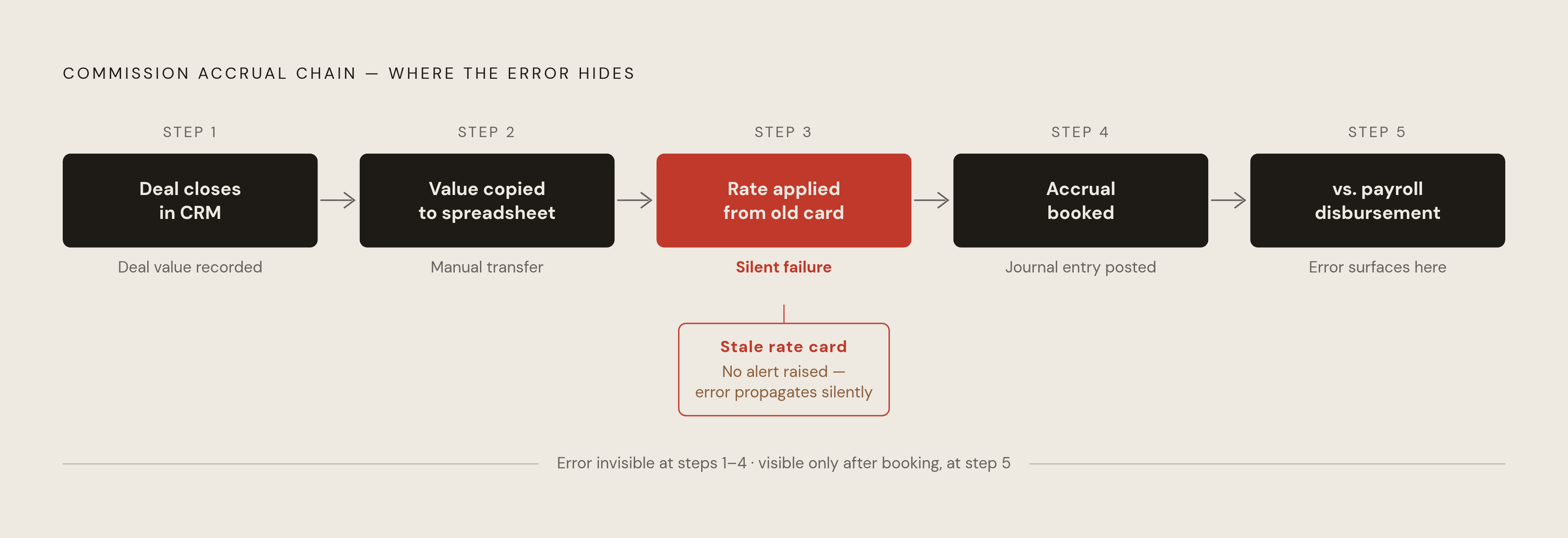
A well-designed plan still produces an inaccurate accrual if a spreadsheet is the thing calculating it. Spreadsheets fail here because the seams between CRM, spreadsheet, and payroll are structurally invisible to the people running the process. A VLOOKUP pulls from a rate card that's a quarter out of date. A manual override gets applied for one edge case and is never removed. None of these trip an alert, and every one of them flows silently straight into the accrual. The hardest version of this to catch lives between systems rather than inside any one of them: a deal closes in the CRM, its value gets copied into a spreadsheet, a commission rate gets applied from a tab nobody updated since last quarter's plan revision, and the resulting figure becomes the journal entry for the accrual. Every step in that chain looks correct in isolation. The error only appears once the accrual is compared against what payroll actually pays, and by then it's already booked.
Companies relying on manual commission processes typically lose a measurable share of total incentive compensation to overpayments and calculation errors, and that money shows up in the accrual books as a liability that never actually settles at the amount recorded. Territory realignment in the middle of a quarter compounds the exposure, since spreadsheets have no clean way to apply retroactive ownership changes, which forces the accrual for the affected period to be rebuilt by hand and gives the error another chance to recur. For an individual rep, the stakes are not abstract. Errors in commission calculations can affect a meaningful share of a sales rep's annual earnings, making the accrual error at the heart of this a material misstatement of one person's earned compensation, carried on the company's books as if it were settled fact.
The downstream effect on RevOps reporting when accruals and actuals diverge
Commission accrual drift doesn't stay contained to a single payroll journal entry. It travels into the revenue efficiency and cost-of-sales figures that RevOps reports to leadership, turning what began as a Finance reconciliation issue into a RevOps reporting integrity issue. The Sales Efficiency Ratio, which measures revenue added per dollar of sales spend, and Cost of Revenue Operations both take commission expense as an input. An accrual that runs high or low by even a few percentage points shifts these ratios enough to influence headcount decisions and investment calls at the leadership level. Forecast accuracy takes the same hit from the cost side. When the commission liability baked into a forecast comes from a spreadsheet accrual that Finance will later revise, that revision appears as a variance in the forecast, making it look worse than the underlying revenue performance actually was.
CRM data alone cannot be trusted to represent timing and recognition correctly. Every number has to be confirmed against the accounting system before it goes out as a result. Commission accruals are exactly the point where CRM deal data and accounting recognition have to agree, and when they don't, the CFO and the CRO are reporting from different realities. That disagreement now lands squarely on the CFO's desk. CFOs have become central to RevOps precisely because they link data integrity to financial governance, and a commission accrual that doesn't reconcile with payroll actuals is a data integrity failure that belongs to the CFO's office, not just the compensation team.
The effect reaches further than financial reporting. A rep who isn't confident that an accelerator above quota will be calculated correctly may simply hold a deal rather than push it to close at quarter end, and that suppressed revenue, a direct consequence of distrust in the commission process, is invisible in every pipeline metric. Trust erosion also breeds a second dataset. Reps start keeping their own commission tracking in parallel spreadsheets, and that shadow record appears in every pay dispute, consuming RevOps and Finance time to reconcile against the official numbers.
ASC 606 and the audit dimension of commission accrual accuracy
Commission accrual accuracy carries both a compliance obligation and an operational one. Under ASC 340-40, the companion standard to ASC 606, a misstated accrual counts as an audit finding, not routine process friction. Sales commissions have to be capitalized as contract acquisition costs and amortized under ASC 340-40 rather than expensed the moment they're paid, so the accrual has to track not only what's owed to the rep but what's recognizable as expense in each specific period. As contract volume grows and pricing gets more complex, the risk concentrates in a few recurring spots: contract modifications that land late in a period, standalone selling price allocations applied inconsistently across similar deals, and deferred commission schedules sitting in spreadsheets that are disconnected from whatever tool handles revenue recognition.
Automating revenue recognition inside an ERP connected to the CRM changes where audit evidence comes from. The audit trail populates from the same data driving the journal entries themselves, so the evidence exists because of how the system was built rather than because someone reconstructed it after the fact. That distinction is what separates a clean audit from a findings letter. The operational controls that make ASC 340-40 compliance auditable, locked pay periods, logged approvals, and period-end commission reports that can't be altered retroactively, are the same features that make commission accrual accuracy trackable as a RevOps metric in the first place. Compliance and measurement run on the same infrastructure here, not two separate ones.
Defining commission accrual accuracy as a formal RevOps metric
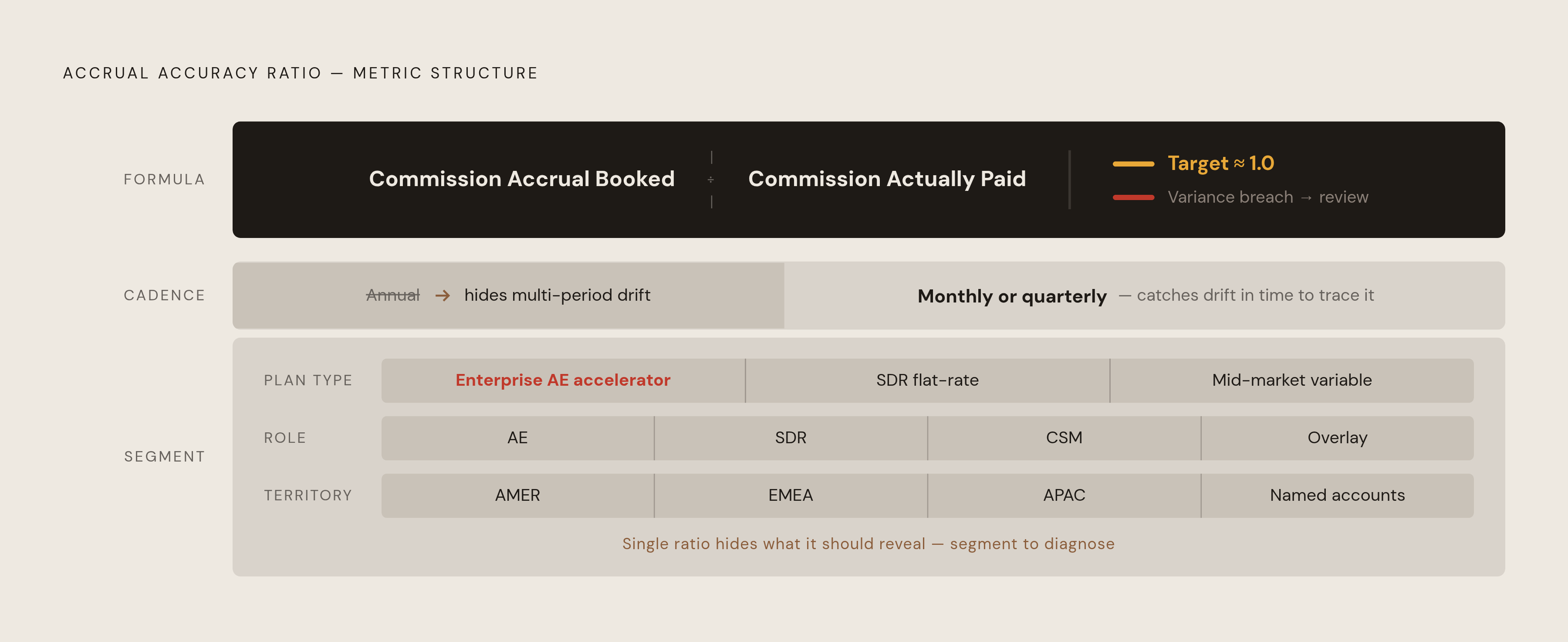
Tracking commission accrual accuracy formally requires a precise definition. For each pay period, divide the commission accrual booked at close by the commission amount actually paid in payroll for that period. A ratio close to 1.0 indicates the accrual was accurate. Persistent drift above or below that line signals a structural problem somewhere in plan modeling, data integration, or calculation logic.
Cadence matters as much as the formula. Measuring this annually only reveals problems after they've already distorted several reporting periods. Measuring it monthly or quarterly catches drift early enough that someone can trace it to a root cause before it compounds across the year.
Segmentation is what turns the ratio from a single number into a diagnostic tool. Break the metric out by plan type, role, and territory, because an enterprise AE plan with accelerators behaves differently from an SDR flat-rate plan, and folding them into one company-wide ratio hides exactly where the process is breaking down.
A threshold matters more than a precision target. Plans with accelerators and tiered structures will always carry some timing uncertainty. The goal is a defined variance band, with a clear trigger for when a reading outside that band prompts a root-cause review rather than a shrug.
None of this works without assigned ownership of each input. RevOps owns the metric's definition and the cadence on which it gets tracked. Finance owns the accrual input that goes into the ratio. The compensation system or commission software owns the approved-amount input against which the accrual gets checked. Clear ownership of each piece is a prerequisite for the metric to mean anything at all.
The workflow that makes commission accrual accuracy trackable: from plan rules to payroll reconciliation
The metric only holds up if the workflow behind it connects plan rules to payroll in a traceable line. Plan rules get defined and documented first, with the Quota-to-OTE ratio and the three-measures guideline serving as the structural checks before a plan ever reaches a rep. Deal data flows from the CRM into a calculation engine governed by those documented rules rather than a spreadsheet maintained by hand. The calculated commission becomes the accrual booked at period close, and that figure gets compared against the actual payroll disbursement for the same period using the accrual-to-actual ratio. Where the ratio drifts outside the agreed variance band, the segmented view by plan type, role, and territory points directly at where in the chain, plan design, data integration, or calculation logic, the gap originated. Locked pay periods and logged approvals preserve the audit trail at every step, so the same workflow that keeps the metric trackable also keeps the organization audit-ready under ASC 340-40.