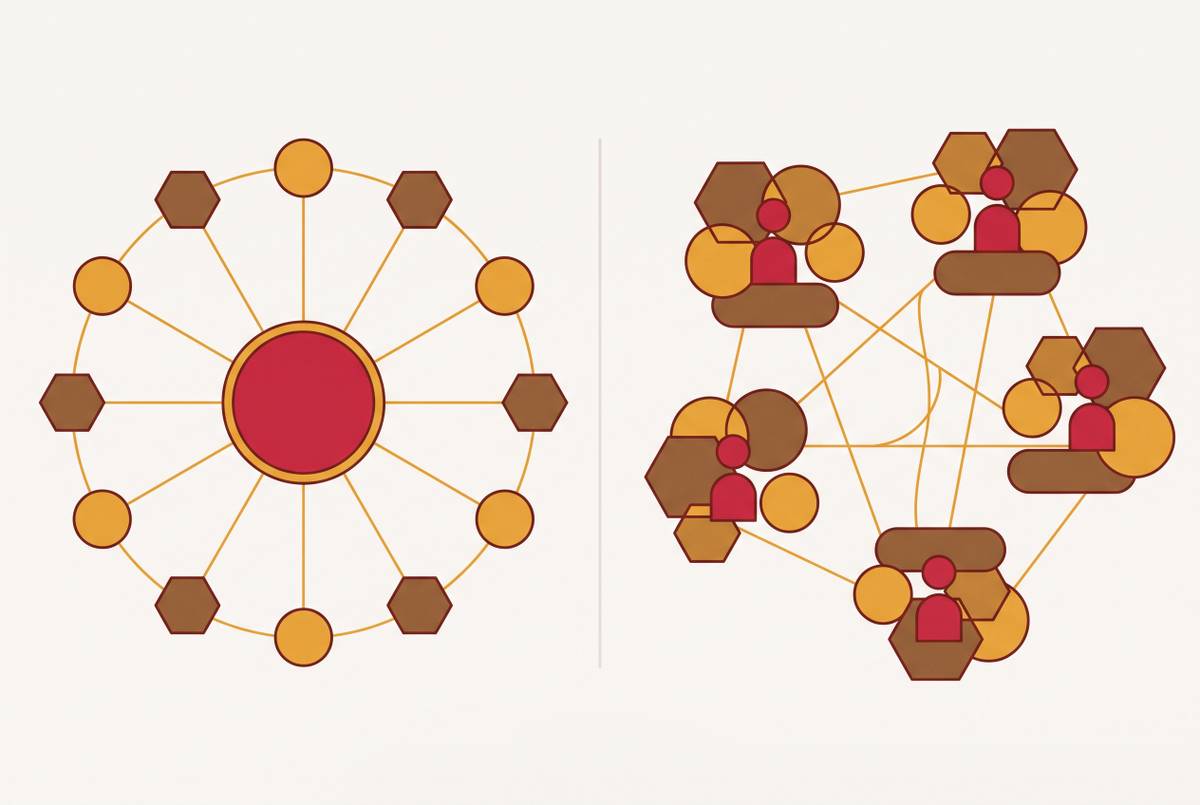
RevOps Reporting Lines to CFO vs CRO
Three reporting structures suit different RevOps mandates depending on organizational priorities.

There is no universal correct answer to where RevOps should report, and the evidence from 2026 bears that out rather than resolving it. Pave's analysis of 746 companies with dedicated RevOps teams found Operations leading as the most common reporting line across every company size, Finance strongest at the earliest stages, and Sales reporting growing sharply as companies scale. Three different dominant structures exist at once across the market, and each is defensible under the right conditions but wrong under others. The conversation keeps resurfacing because the stakes attached to it are concrete: Strativera has observed that putting RevOps under the wrong leader creates conflicts of interest, cuts off access to data the function needs to do its job, and leaves RevOps unable to drive change across departments, so the whole organization slows down waiting on decisions that never quite land. Given that, what the organization most needs RevOps to accomplish over the next 12 to 24 months should drive the decision, not an abstract preference for reporting to the CRO or the CFO.
No single reporting structure is universally correct for a RevOps team, and the right answer depends on what the organization most needs RevOps to accomplish over the next 12 to 24 months. CRO reporting works best when the priority is pipeline growth and GTM velocity; CFO reporting works best when the mandate is margin discipline, pricing rigor, and forecast accuracy; CEO reporting suits the narrower case of company-wide operating model transformation. Regardless of which line is chosen, the practical resolution is to codify explicit decision rights over data definitions, territory design, forecasting, and commission governance so that RevOps maintains cross-functional credibility rather than being captured by one side of the business.
What RevOps does
RevOps generates value by sitting between functions rather than inside any single one of them, and that positioning is what makes its reporting line consequential rather than incidental. Shreyansh Surana at RevX describes the function around three pillars: process, the definition of what processes exist across every revenue-generating department; platform, ownership of the CRM, the broader tech stack, and adoption rather than merely configuration; and data, an honest pipeline picture that tells leadership where the business is actually heading. Adam Chen, CRO at FinStrat Management, argues for a fourth pillar: finance. Leaving finance out of that alignment produces an incomplete picture, since marketing, sales, customer success, and finance all feed into the same revenue outcomes and none of them operates in isolation from the others. Pave's own framework converges on something similar, describing three core areas a mature RevOps team covers: systems and tooling (CRM ownership, integration architecture), data and analytics (pipeline reporting, forecast accuracy, revenue attribution), and process and enablement (quota setting, territory design, compensation plan modeling).
Of those areas, the reporting line matters most for data and analytics. Systems work and process design are relatively insulated from internal politics because a CRM field either exists or it doesn't, and a territory map either resolves overlaps or it doesn't. Who owns the revenue narrative, and who has the standing to deliver an inconvenient truth in an executive meeting, depends heavily on where RevOps sits in the org chart. Commission governance sits precisely at this intersection. Commission processing is simultaneously a CRO priority, because it shapes rep motivation and pipeline behavior, and a CFO priority, because it governs accrual accuracy, audit trails, and the integrity of financial close. That dual pull is why commission calculation platforms like Quota Queue, which automate processing with auditable approval workflows and payroll-ready exports, function as something close to a litmus test: whichever side RevOps appears to favor in how commission disputes get resolved reveals whether the function has genuine cross-functional authority or has quietly been captured by one side of the business.
The foundational condition: RevOps can only solve a GTM problem, not substitute for one
The entire reporting-line debate assumes RevOps is already the right answer to whatever problem the organization is facing, and often the conditions that would make it the right answer haven't been built yet. A B2B SaaS company eighteen months into its life built out a RevOps function, stood up CRM dashboards, and set up attribution reporting. Six months later, pipeline metrics looked clean and organized, but conversion had stayed flat the entire time. The underlying issue had nothing to do with RevOps: marketing was nurturing mid-market prospects while the founders were closing enterprise deals on the side, with no documented ICP and no agreed sales motion anywhere in the business. RevOps had given the company a clean system for running two incompatible go-to-market strategies at once, tracked with precision and reported on schedule, and none of it could fix a go-to-market problem that the function was never designed to solve.
A separate case makes the same point from another angle. A CFO at one RevX client didn't trust the pipeline data reaching the executive team, and the data itself wasn't the issue. By the time revenue updates reached that CFO, they had passed through enough layers of interpretation that nothing about them was confidently verifiable. The fix was automated pipeline notifications that let finance see updates directly, before interpretation had a chance to creep in, not a reporting structure change. The org chart had nothing to do with the actual problem, which was a data flow issue masquerading as a governance issue. Before any organization picks a reporting line for RevOps, it should confirm that the go-to-market motion is defined, that the ideal customer profile is agreed upon across departments, and that CRM data is reliable enough to be worth optimizing. Only once those conditions hold can the reporting debate become a real decision, not a distraction from the actual problem.
What is the best organizational structure for a RevOps team?
Once those foundational conditions are in place, the right reporting line follows from what the organization most needs RevOps to accomplish over the next 12 to 24 months, and those mandates tend to sort cleanly into three categories: growth velocity, cost optimization, and cross-organizational transformation. The Pedowitz Group's decision matrix lays out three corresponding scenarios, and each one comes with real trade-offs, not a clean win. The CRO reporting line works best when the priority is pipeline growth, tighter GTM alignment, faster conversion, and coordinated plays across marketing, sales, and customer success, since it gives RevOps a direct line to revenue and shortens the path to decisions, though it depends on a strong CFO partnership to keep margins and forecast accuracy from drifting. Reporting to the CFO works best when the priority is margin discipline, pricing rigor, and forecasting accuracy, since it brings strong analytical control to the function, though it carries real risk of GTM misalignment if revenue leaders aren't given genuine co-ownership of the roadmap. Reporting to the CEO works best in the narrower case of re-architecting the operating model company-wide: the mandate is broad enough and the authority needed is cross-organizational enough that neither the CRO nor the CFO can carry it alone, but that arrangement competes for the CEO's limited attention and puts real distance between RevOps and day-to-day GTM execution, so it belongs in the toolkit for breaking long-standing data or process silos, not as a default choice.
None of these three options is superior in the abstract, and that point deserves emphasis because the most common mistake organizations make is defaulting to the CRO simply because it sounds revenue-positive, without checking whether the organization's actual 12-to-24-month priority is financial discipline rather than growth. The CRO model tends to produce the strongest results for mid-to-late stage companies that are prioritizing revenue growth and go-to-market velocity, but that comes with an honest trade-off: RevOps loses proximity to financial decision-making when it sits under a CRO who lacks financial rigor, and no amount of process discipline inside RevOps compensates for that gap at the top. CFO reporting, by contrast, works well when the primary mandate is optimization rather than expansion, but it carries a structural risk of its own, since RevOps focus can shift toward cost reduction and efficiency in ways that limit pipeline velocity and make sales and customer success reluctant to share details with a function they perceive as finance-aligned. When RevOps reports to Finance and the mandate is margin discipline and forecasting accuracy, the platform layer that RevOps manages becomes critical in a specific way: not just CRM configuration, but the supporting systems, including commission software, that give Finance real-time visibility into accrual, clawbacks, and compensation liability without depending on spreadsheets or on sales team intermediaries to relay what's actually happening in the pipeline.
Company stage and the CRO's organizational maturity change the calculus
Matching the mandate correctly is necessary but not sufficient, because even a correctly identified mandate can be mis-executed if the leader receiving RevOps isn't structured to hold the function well. The same nominal reporting line can produce very different outcomes, because so much depends on company stage, and on whether the executive at the top of that line has the scope to give RevOps genuine cross-functional authority rather than a narrower, department-specific mandate.
Early-stage companies often default to Finance reporting out of necessity, not principle. Pave has noted that at very small companies, Finance and Operations often overlap in practice, and early-stage founders sometimes structure RevOps close to the CFO simply because no CRO exists yet to take it. That arrangement is pragmatic rather than prescriptive, and at this stage one or two people typically cover all three RevOps pillars, systems, data, and process, at once. The reporting line matters less here, because the function isn't yet exerting the kind of cross-functional authority in executive meetings that would make the choice politically loaded.
CRO reporting carries structural risks that scale directly with the CRO's own scope. Fullcast has found that CRO-aligned RevOps often lacks financial rigor if it doesn't have a strong CFO partnership, drifts toward being too sales-focused if the CRO's scope doesn't extend to customer success and marketing, and needs a CRO who treats operations as a strategic function, not a reporting service that exists to produce dashboards on demand. RevOps Co-op practitioners have made a related point: the VP of Revenue Operations needs to sit on equal footing with the VPs of Sales, Marketing, and Customer Success, not subordinated to any one of them, because a RevOps function reporting to a function head rather than a C-suite leader will inevitably be asked to design and report for that department's priorities first. Strativera has flagged the same failure mode from a different angle, noting that reporting to department heads such as a VP of Sales or a CMO is usually the wrong structure, since it forces RevOps into a position where it has to pick sides, which defeats the premise of cross-functional alignment that justified creating the function. The Finance-led model, for its part, works best under specific conditions: a CFO with genuine operational background, a company culture that already treats data discipline seriously across the GTM organization, and a RevOps team resourced to operate strategically rather than simply produce reports on request. Those conditions are specific to the organization holding them, not universal guarantees that come bundled with the CFO title.
The neutrality problem: bias in data and commission governance
No mandate-based framework fully resolves a deeper tension: whoever owns RevOps biases it, and in commission management specifically, that bias carries direct financial and trust consequences for every rep and every finance team member in the organization. When RevOps reports to a CFO, Strativera has observed that GTM teams grow wary of sharing deal details with a finance-aligned function out of fear of budget scrutiny. That wariness damages the data quality commission calculations depend on: once reps and managers start treating the CRM as an audit mechanism rather than a tool built to support them, they stop updating records with the same accuracy. When RevOps reports to a CRO, Pave has observed the mirror-image effect: a Sales-reporting RevOps function is structurally incentivized to support the sales team's version of events, and in commission contexts that means disputes tend to resolve in sales' favor, accrual accuracy suffers, and Finance loses trust in the numbers it needs to close the books.
Commission management is where this tension plays out most visibly, because the process sits exactly at the intersection of CRO priorities, rep motivation and pipeline behavior, and CFO priorities, accrual accuracy, audit trails, and financial close. Which leader owns that process shapes whether commission management functions as a tool that builds trust across the revenue organization or settles into a back-office function that reps and finance both regard with suspicion. The trust deficit behind this is already substantial, since industry data shows that 5 to 10% of all commission calculations contain errors in organizations still relying on spreadsheets. If you have worked inside RevOps or Finance, you have likely seen a version of this firsthand: a rep quietly tracking their own commission math in a side spreadsheet because the official process feels opaque or compromised. The stakes around this have also shifted from internal embarrassment to external compliance risk. Pay transparency laws in states including California, New York, and Illinois, effective in 2025, now require employers to disclose pay ranges in job postings and, for commission-based roles, to disclose that the position is commission-based, with California going further and requiring the expected commission range or calculation formula to appear in the posting itself. If a commission governance failure once stayed inside the walls of a company, it now carries legal exposure the moment it touches a job listing.
The hybrid model and decision-rights design as the practical resolution
Given that no single reporting line is free of bias, the practical resolution for most organizations is to design explicit decision rights and cross-functional governance that hold regardless of which reporting structure sits on top of them, rather than to keep searching for the one correct place to put RevOps. The Pedowitz Group's framework lays out what RevOps should own no matter who it reports to: data definitions, lifecycle stages, routing logic, territory design, the forecasting process, tech stack governance, and reporting itself. If you codify those as decision rights, rather than leaving them to whichever executive happens to hold the reporting line that quarter, RevOps can maintain credibility with both sales and finance at once. A hybrid model, where RevOps reports administratively to one executive but holds a documented charter of cross-functional authority over those specific domains, gives the function a way to resist the gravitational pull toward either the CRO's narrative or the CFO's narrative. This matters most in commission governance, where the decision rights over calculation logic, dispute resolution, and audit trail ownership need to sit with RevOps as a function, not with whichever side of the sales-versus-finance divide happens to be winning the argument that month. Before any organization can layer in end-to-end commission management tools that depend on clean, consistent input data, the underlying GTM motion needs to be stable, meaning deal data, sales process, and quota methodology are already defined and agreed upon across the business. Once that groundwork exists, the reporting line becomes a structural choice made in service of a clear mandate, a decision rather than a political outcome imposed on a function still searching for its footing.