Sales Ops Professional Moving Into RevOps
Shifting from executing commission calculations to governing the system behind them.

Every Sales Ops professional knows the monthly scramble: pulling exports from the CRM, re-running formulas against a spreadsheet that's one tab removed from falling apart, sending statements out, and then fielding the inevitable string of disputes from reps who think their number is wrong. That scramble is a symptom of how commission work gets scoped in a Sales Ops function: as a calculation problem, bounded by pulling data, running formulas, and sending a statement, with clerical ownership and limited accountability to anyone outside the sales team. Moving into RevOps does not mean doing that same scramble faster or with fewer errors. It means redesigning the system that produces the scramble in the first place: commission management in a RevOps context is a governance structure spanning Finance, Sales, and the data architecture that sits beneath both, not merely a task.
That shift in framing is the clearest test of whether a Sales Ops professional is ready for RevOps scope. Commission management asks a direct question: who owns the source data, who has authority to interpret an ambiguous plan clause, who is accountable when Finance and Sales disagree about what a closed deal is worth, and does the compensation system actually reinforce the revenue strategy it was supposed to serve. None of those questions can be answered by running a formula correctly. They require the professional to operate as a governance owner rather than an executor, which is the entire distance between Sales Ops and RevOps compressed into one operational domain.
What's notable is that the skills this shift demands are not new skills. Plan design literacy, awareness of data architecture, integration with Finance workflows, and rep-facing transparency are already latent inside Sales Ops commission work. They are simply never developed or owned at that level, because the role was never scoped to require it. The rest of this piece works through what changes when a professional is handed that scope deliberately, starting with plan design itself.
Commission Plan Design for the RevOps Owner
A commission plan exists to connect effort to reward in a way a rep can predict and act on. The RevOps owner of that plan carries accountability for making sure the connection holds, because a plan that cannot be mapped clearly from behavior to payout stops motivating the behavior it was built to produce. That accountability did not exist in the same form under Sales Ops, where the plan arrived from Sales leadership and the operational job was to calculate against it, not to question whether its mechanics made sense.
Simplicity sits at the center of that accountability. A plan that cannot be explained in under a minute has already failed as a motivational tool, independent of whether its math is correct. Reps act on what they understand; a formula buried under tiers, accelerators, decelerators, and exception clauses stops functioning as an incentive the moment a rep cannot reconstruct, in their head, what closing the next deal is worth to them.
Role-specific design follows from that same logic, and it belongs to RevOps rather than to Sales leadership as a courtesy. An SDR should earn on outcomes within their own control, such as qualified meetings booked or SQL conversion rate, rather than on closed revenue that depends on an AE's performance further down the funnel. The common hybrid model for SDR compensation exists precisely to avoid two failure modes: paying solely on meetings booked, which rewards volume over quality, and paying solely on closed deals, which punishes an SDR for outcomes an AE controls. Multi-role deals raise a related design question. Primary and secondary credit allocation, and the caps attached to each, need definition before a deal closes rather than adjudication after, because ambiguous attribution rules are one of the most common sources of compensation disputes.
Payout timing is where plan design meets Finance directly, and RevOps has to own that bridge rather than leave it implicit. Paying commission at booking, at invoicing, or at cash collection each carries distinct consequences for cash flow and revenue recognition, and misalignment between when a rep gets paid and when the business recognizes the related revenue is a recurring source of friction between Sales, Finance, and leadership. One practical mechanism for managing that risk is splitting a commission payout between the booking event and the first invoice collection, which ties part of the reward to cash actually arriving rather than to a bookings number alone.
None of this reaches production without testing. Running historical deals through a new or revised plan before rollout reveals payout outliers and edge cases in testing, while they're still cheap to fix. Plans that skip this step tend to hit the same problems mid-quarter instead, at which point correcting them requires retroactive adjustments, and retroactive adjustments erode a rep's confidence in the system paying them.
Where Sales Ops commission work breaks structurally
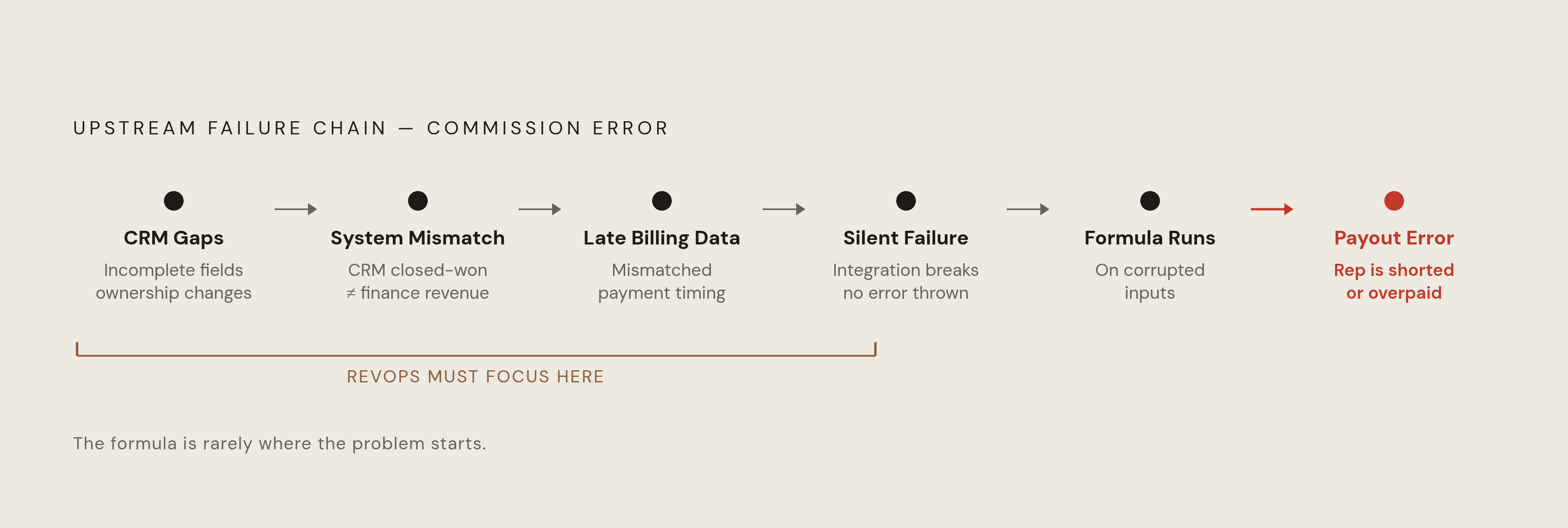
Every Sales Ops professional recognizes the specific failure points: a deal closes in the CRM but never maps to the right commission plan, a rep crosses a quota threshold and the new rate tier doesn't apply automatically, a split deal credits the wrong person, or a territory change mid-quarter leaves attribution ambiguous. None of that happens because someone was careless. These are predictable failure points that scale directly with headcount and plan complexity, and they will recur in any organization that has not built the architecture to prevent them.
The deeper issue sits one layer below the formulas, in the mismatch between what a CRM records and what a finance system recognizes. A CRM marking a deal "closed-won" is recording a sales milestone, not a financial one, and that milestone rarely lines up with what an accounting platform treats as recognized revenue. Multi-stage renewals and upsells widen that gap further, so that by the time commissions actually run, the payout logic may be operating against figures Finance would never count as realized income. Commission errors, in other words, usually start upstream of the calculation: incomplete CRM fields, inconsistent deal types, account ownership that changed mid-cycle, billing data that arrived late, payment status that doesn't match the commission period, or product SKUs mapped to the wrong category. The formula is rarely where the problem starts.
Manual processes make all of this worse instead of catching it. Ad hoc execution, especially the practice of emailing spreadsheets between Finance and Sales to reconcile numbers, carries security and audit risk on its own, and it also erases the deal-level attribution that financial reporting and audit defense depend on. Once that attribution is gone, reconstructing it after the fact is close to impossible.
Inheriting a Sales Ops commission environment means inheriting that reconciliation gap, beyond just the spreadsheet that currently papers over it. Owning the fix requires knowing where the source data physically lives, how it moves between systems, and what can corrupt it before it ever reaches a commission calculation. That is an architecture question, and it's the one RevOps is specifically positioned to answer.
Rep trust as a measurable operational output, not a culture metric
When a rep cannot verify their own commission number against a statement from Finance, a predictable thing happens: they build a parallel spreadsheet and track every deal themselves. That shadow accounting is a rational response to a system that will not show its work, and its presence inside a sales team is a leading indicator that the commission system itself has failed.
The cost of that response is measurable. Every hour a rep spends reconciling their own deal tracking against a Finance statement is an hour not spent on pipeline, and every hour Finance spends fielding a dispute is an hour not spent on planning. As a sales team's hours of reconciliation accumulate across a quarter, the opacity of a commission system becomes a direct drag on the revenue the system was supposed to be incentivizing.
The fix is structural: reps need ongoing visibility into performance, attainment, and expected earnings throughout the incentive period, not a single statement that arrives after the period has already closed. A dashboard that shows a rep what their payout would look like if they closed a specific open opportunity today removes the uncertainty that drives shadow accounting in the first place, because it answers the question before the rep has to go build their own answer.
Pay transparency is increasingly a compliance requirement in some jurisdictions as well as a best practice; the RevOps professional who treats rep-facing visibility as optional may be operating outside legal requirements that are still emerging. Eliminating manual override adjustments reinforces the same goal from a different angle: defining the rules for refunds, churn, and multi-year deal structures in advance, and automating how those rules apply, removes the sense that any individual adjustment was arbitrary. Trust, in this framing, is downstream of how the system is built. It cannot be recovered through better communication if the underlying calculation remains opaque, and the transparency that prevents shadow accounting is the same transparency Finance will eventually need for its own governance purposes.
Restructuring the Finance-RevOps workflow around commission governance
Sales and Finance are optimizing for two different things. Sales wants speed: fast closes, immediate credit for a deal, payout in the current period. Finance wants control: recognized revenue, a clean audit trail, a predictable cost of sales. Spreadsheets force those two goals into a trade-off rather than letting them coexist, because a spreadsheet has no mechanism for enforcing financial recognition rules at the same moment it's calculating a rep's payout. RevOps's job is to design a commission system where speed and control stop competing for the same calculation.
The stakes of getting this wrong extend past a single rep's paycheck. A missed amortization schedule does not show up as a payout error that a rep disputes and Finance corrects. It produces a restatement, which is a legal and financial event with consequences well beyond the commission plan that triggered it.
Resolving that tension starts with a RACI model for commission ownership, built as a concrete deliverable rather than left as an ongoing management conversation. Finance, RevOps, Sales Operations, and IT need to agree on who is responsible for what before a platform is selected, before implementation locks in assumptions none of them approved.
Auditability belongs in that design from the start. A commission system that cannot trace a specific payout back to its source data and the rules applied to it cannot defend that payout in a Finance review, and it cannot defend it to the rep disputing it either. Locked pay periods and logged approvals are what turn a commission calculation into a defensible record: once a period is locked and every approval is logged, no adjustment can happen without leaving a trace, and any disputed period can be reconstructed rather than relitigated from memory. Plans still need room to change going forward. A compensation structure revised mid-year has to apply its changes prospectively, leaving the historical record from prior periods intact rather than retroactively altering what reps were already paid under.
CRM data integration as the foundation RevOps must validate before anything else
Commission accuracy can only be as good as the CRM data feeding it, and the most common blind spot in a commission system transition is assuming that an integration existing between two systems means the data moving through it is accurate.
Integration exists on a spectrum, and most implementations stop well short of the reliability end of it. A connection between a CRM and an ERP or payroll system typically assumes the data arriving is correct rather than verifying it, so a missed field update or a duplicated deal record can inflate a performance metric and distort a compensation calculation without ever throwing a visible error. Nothing in the system flags that anything went wrong, which is what makes this failure mode harder to catch than an obvious formula bug.
Reconciliation checkpoints are the design answer, and they belong to RevOps rather than waiting to be caught by a Finance audit after the fact. Without checkpoints built directly into the workflow, errors compound silently, period after period, until a rep dispute finally reveals a discrepancy that may have been accumulating for months.
Platform-specific verification matters here too. Mid-market RevOps environments commonly run Salesforce and HubSpot in parallel, and connector depth is not uniform across either platform. Write-back capabilities, including custom fields, picklists, bidirectional sync, and conflict detection, need to be verified individually for each CRM in use rather than assumed from a vendor's general marketing claims about integration. Before any commission system transition goes live, that verification is the audit RevOps has to run first: confirming what each connector actually writes back, under what conditions it fails silently, and where the data a commission calculation depends on could already be wrong before the formula ever runs.