RevOps Director vs VP Title Differences in Practice
VP owns strategy and structure; Director executes the plan daily.

The gap between a Director of Revenue Operations and a VP of Revenue Operations is structural, independent of years in the role or size of paycheck. When a quarter misses, the two titles answer for different failures: the VP answers for the plan, and the Director answers for the execution. If the model is wrong, built on bad segmentation or compensation that rewards the wrong behavior, it's the VP's problem to own. A broken forecast, a CRM nobody trusts, or a quota load that didn't go out on time belongs to the Director. That split carries weight for three decisions every growing company has to make correctly: who to hire next, where that hire reports, and which workflows, including compensation and quota operations, sit under each title.
Title inflation has made this harder to read from a job posting alone. Plenty of listings for "Director of Revenue Operations" describe what used to be called Director of Sales Operations, with marketing and customer success operations left out of the scope. Plenty of people with both titles, Director and VP, do work that would have been called Manager-level just a few years earlier. None of that changes what the roles are supposed to own when they're built correctly. It does mean the title on a business card or professional profile tells a hiring manager, a RevOps professional benchmarking their own scope, or a Finance leader trying to figure out who to call less than the accountabilities underneath it do.
What the VP of Revenue Operations owns
The VP of Revenue Operations designs the go-to-market model. That means deciding how sales, marketing, and customer success are organized relative to one another, how territories and quotas get structured, how compensation is built to drive specific behavior, and which platforms the revenue organization runs on for the next several years.
The reporting line is the clearest signal of whether this role exists in substance. A revenue operations leader who reports into the VP of Sales is not sitting in that seat. That person is a senior Sales Ops professional with an elevated title, and the organization has not built a function that coordinates sales, marketing, and customer success under one strategic owner.
In practice, the VP sets compensation philosophy, and territory and quota design both need sign-off before they go live. The VP owns the forecast methodology the board sees and the definitions behind every revenue metric the company reports internally and externally. The VP decides which platforms the revenue team buys, keeps, or retires, and signs the contracts for the large ones. The VP hires and develops the Directors below, and represents the function in front of the executive team.
The KPIs attached to this seat are the ones a board reviews: revenue and bookings against plan, net revenue retention, CAC payback and LTV-to-CAC ratio, sales capacity measured as ramped reps times productivity per rep, and annual forecast accuracy. Incentive compensation belongs in this portfolio as a strategic item, not an administrative one. The VP aligns comp philosophy with the CRO and signs off on vendor contracts for commission tooling, platforms like Quota Queue among them, but the daily work of running that compensation plan sits with the Director.
What the Director of Revenue Operations owns
The Director of Revenue Operations runs the department day to day. That includes the forecast calls, the CRM and tool roadmap, the data rules that keep records clean, and the managers, analysts, and admins who keep the machine running on a weekly basis.
Where the VP sets the annual plan, the Director turns it into operations: carving territories, loading quotas into whatever system the team uses, and building the calendar for QBRs and sales kickoffs. The Director runs the weekly forecast process and owns the dashboards that sales, marketing, and customer success leaders check to know where they stand. The Director owns the CRM roadmap, covering configuration, integrations, new-tool rollouts, and getting reps to actually use what's been built. The Director enforces the data rules that make all of that trustworthy: required fields, lead routing, deduplication, and enrichment. Spending happens inside the budget the VP allocates, covering headcount costs, software license renewals, and project-specific expenses, but the Director does not set the overall strategic investment the organization is making.
The KPIs here are operational and predictive rather than board-facing directly: pipeline coverage for the current and next quarter, stage conversion and pipeline velocity, weekly forecast accuracy, sales cycle length, and CRM data completeness and tool adoption. These numbers tend to move before the board-level numbers do, which is part of why a Director who is doing the job well gives the VP early warning.
The title covers a wide range of actual seniority. A mid-level RevOps professional with the Director title might lead territory and quota planning, manage forecasting workflows, and oversee commission plan administration, and at a smaller company, that work would count as a full Director's scope. That range is why the title alone can't tell a reader what a given Director actually does: the reporting line and the specific accountabilities have to be checked. Commission management sits in this bucket as a core execution responsibility: the Director evaluates, implements, and runs the commission software the team depends on, configuring the rules and plan logic that the VP designed, running approval workflows, and managing the daily administration that turns comp strategy into payroll-ready statements. The Director plans on a quarterly and annual horizon, translating the VP's multi-year vision into what has to happen this quarter.
How reporting structure reveals whether an org has separated the roles
Titles alone won't tell you whether a company has genuinely split the Director and VP functions. The reporting chain and the budget ownership will.
In a company that has built the split correctly, the chain runs from the CRO to the VP of Revenue Operations, then to the Director, then to the RevOps managers, analysts, and admins doing the daily work. At smaller companies, the Director sometimes reports directly to the CRO with no VP layer above, a legitimate structure in its own right. The VP sits one step from the executive team. The Director sits one step from the people doing the work. Either position is fine on its own; what matters is whether the chain matches the title.
A senior RevOps person reporting into the VP of Sales, rather than the CRO, COO, or CEO, signals that the organization has Sales Ops with an upgraded title rather than a cross-functional RevOps executive, and marketing and customer success operations tend to stay uncoordinated as a result. Budget ownership tells the same story from another angle: a genuine VP owns the RevOps budget and signs the large contracts, while the Director manages spend within whatever the VP allocates. When both people seem to be doing that same thing at the same level, one title is covering two different jobs, and something in the structure needs clarifying.
Many organizations run a single "Head of Revenue Operations" title instead, with one person covering both levels of work. That's a common and reasonable structure for a smaller team, where the person holding the Director title is also carrying part of the VP's strategic scope. Title inflation adds a further diagnostic difficulty: the widespread shift from "Director of Sales Operations" to "Director of Revenue Operations" or "Head of Revenue Operations" reflects a real expansion of scope toward the full customer journey in many companies, while in others the title changed and the job underneath it didn't.
Hiring a Director first versus hiring a VP first
The right hire depends on what kind of pain the organization is actually feeling, not on headcount or ARR by themselves. A company can be large and still need a Director before it needs a VP, and a smaller company with a genuinely broken go-to-market model might need the VP first.
Hire a Director when the pain is execution. The signs are concrete: commissions that take days to reconcile every month, forecast calls that run without an agreed methodology, CRM data that different teams read differently because nobody enforced a shared definition, and territory assignments that nobody on the sales team actually trusts. These are systems and process failures, and a strong Director closes them by building the discipline and tooling the team is missing.
Hire a VP when the pain is in the model itself. Unclear market segments, a compensation plan that quietly rewards the wrong behavior, or a capacity plan that doesn't match what the company can actually afford to hire are all signs that the architecture needs rework, not better execution of a flawed design. A Director can run a bad model efficiently and still get bad outcomes, because the problem sits one level above where that role operates.
When a small team carries both kinds of pain at once, it usually starts with one Head of RevOps doing both jobs. The split into separate VP and Director roles becomes necessary once the team's growth makes it impossible for one person to do the strategic work and the operational work without one of them suffering.
Altitude split for compensation plan design and commission administration
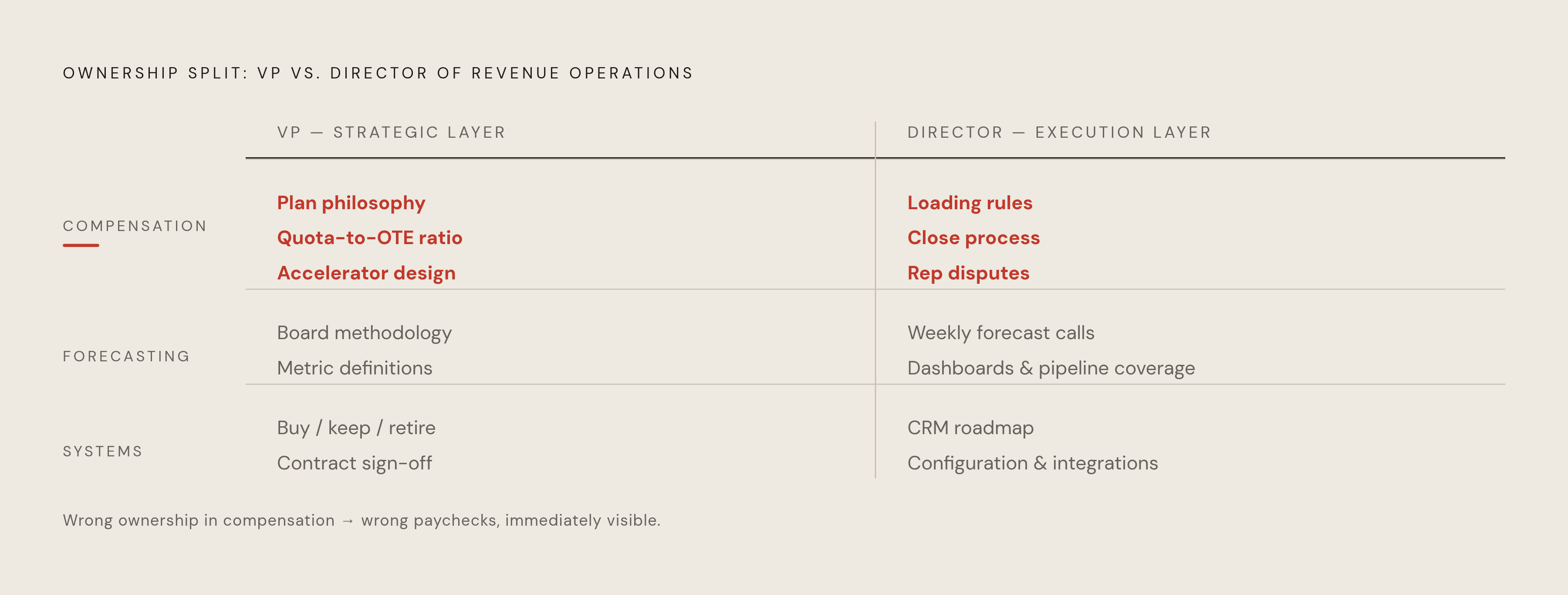
Compensation is where the Director/VP split has the sharpest consequences: getting the ownership wrong here means wrong paychecks, and that damage is visible immediately. Compensation plan design is a VP-level strategic decision. Commission administration and calculation accuracy are Director-level execution responsibilities. Treating those as one job is a common source of accountability gaps.
The VP sets the philosophy: what behaviors the plan is meant to reward, how quota relates to on-target earnings, whether accelerators or caps apply, and how the whole structure aligns with the go-to-market model the CRO has signed off on. The Director owns everything downstream of that decision. That means loading the rules into whatever system the team runs, verifying that deal data flowing out of the CRM lines up correctly with what the commission calculations expect, running the monthly or quarterly close process, and resolving disputes that come in from reps in the field.
The split tends to break down when companies are still running commissions out of spreadsheets. Complex accelerator logic, multi-year ACV rules, and split arrangements between an AE and a sales engineer are hard to manage reliably in Excel, and when the formulas get it wrong, the errors surface as rep disputes that pull VP and CRO attention into what should have been a Director-level fix. Rep trust in the commission number isn't only a morale question. A rep who doesn't trust the payout spends time checking the math by hand instead of selling, and that lost selling time is a direct cost of a broken administrative process.
What structured commission software gives the Director over spreadsheets
Spreadsheets fail the Director because the complexity of real commission logic, tiered rates, accelerators, clawbacks, splits, and multi-year ACV rules, exceeds what any manually maintained formula set can handle reliably once a plan grows past a certain size.
Accelerators need conditional logic that compounds across tiers, with payouts shifting as quota attainment crosses each threshold, and nested IF statements in Excel stop scaling as soon as a plan gets more than a couple of tiers deep. If an AE and a sales engineer split a deal, or two AEs share an account, a formula has to track deal ownership consistently against the CRM export, and that tracking breaks the moment a deal changes hands or a field gets updated late. Clawback rules need the system to remember past payouts and adjust future ones correctly, a retroactive calculation that spreadsheets can only manage through manual audit trails that are easy to corrupt.
Purpose-built commission platforms replace each of those failure points directly. A single import step pulls deal data from the CRM, so you skip the manual export step that introduces errors before any calculation even starts. Rule-based plan configuration, covering tiers, accelerators, SPIFs, and clawbacks, gets set once and applied the same way every period without anyone maintaining formulas by hand. Locked pay periods and logged approvals create an audit trail, so the VP, Finance, and outside auditors can follow it on their own, without pulling the Director in to reconstruct the logic behind a number. Quota Queue is one platform built around this exact workflow, taking deal data through CRM or file import, calculating commissions deterministically, and carrying the process through statements, approvals, disputes, and payout export in one connected system. Its pricing is structured around the number of active compensation plans rather than the number of seats, so as the sales team adds headcount, a Director running the platform doesn't face a growing cost penalty, which is a meaningfully different model from seat-based commission tools as a team scales.
None of that replaces the underlying discipline the Director still owns. When a payout comes out wrong, the root cause is more often dirty CRM data than a flaw in the calculation engine. Field hygiene, correct close dates, and accurate deal amounts in the source system feed every commission calculation downstream, and getting that source of truth right is still the Director's job before any platform, Quota Queue included, can do its part.
What the VP needs from commission tooling at the strategy and compliance layer
Commission software is a Director-level execution tool and infrastructure the VP depends on for compliance and for defending the compensation budget in front of the CRO and the board.
An auditable calculation trail matters at this altitude because the VP is the one who has to explain a payout anomaly to Finance or justify a comp plan's total cost against the budget signed off at the start of the year. A platform that locks pay periods and logs every approval gives the VP a record that holds up under that kind of scrutiny, so the Director doesn't have to rebuild the math from scratch each time a question comes up. That same record supports the VP's broader responsibility for vendor selection: when the VP signs a contract for a commission platform, whether that's Quota Queue or another system the Director has evaluated, the deciding factor is whether the tool produces calculations and audit trails that will hold up to compliance review, not just whether it gets the math right day to day.
The VP's compensation philosophy also only means something if it survives contact with execution. If a plan rewards the right behavior on paper but gets administered inconsistently, through manual spreadsheet errors or inconsistent rule application, it stops reflecting the philosophy the VP designed. Structured commission tooling keeps the gap between the strategic design and the operational reality from widening quarter over quarter. The VP's stake in the tooling decision runs as deep as the Director's, even though the two are evaluating it for different reasons.