Standing Up RevOps as the First Hire
Hiring RevOps first requires fixing commission math before building dashboards.

Standing up RevOps as a company's first dedicated hire is a response to a complexity threshold that's already been crossed. By the time most companies make this hire, sales and finance are working from conflicting numbers, forecasts are breaking, and commission disputes eat hours every pay cycle. The function has moved from experimental to expected fast, and the pace of adoption among high-growth companies reflects how quickly boards came to see it as standard infrastructure. Companies that treat the hire as an afterthought, made only once the pain gets loud enough, are already behind, and the biggest mistake in how they build the role is treating commission management as something the hire gets to later. It belongs on day one, and this piece explains why, in what order the rest of the work should follow.
Companies typically make this hire somewhere between $10M and $50M in ARR, once the cost of cross-functional misalignment gets too expensive to shrug off. Public companies with a dedicated RevOps function have shown 71% higher stock performance and sales productivity gains of up to 21%. Those figures explain why boards ask about this hire before the executive overseeing revenue even brings it up. They also explain the tax that comes with waiting: a company that holds off until $50M has been paying for years in disputes, bad forecasts, and reps who no longer trust their own commission statements.
What this one person is being asked to do
The role, on paper, owns five domains at once: strategic planning and go-to-market design, CRM and tech stack administration, pipeline and forecasting processes, compensation and commission administration, and revenue analytics and reporting. That's not a job description so much as a merger of four job descriptions. Commission administration sits inside it as a core, day-one responsibility, not something the hire gets to once the "real" work is done.
In practice, the breadth looks like this on any given Tuesday: CRM admin and data hygiene, dashboard construction, process documentation, tool evaluation, territory and quota design, commission calculation and dispute resolution, and whatever cross-functional fire needs putting out that week. Under $10M ARR, one generalist usually holds this together. Between $10M and $50M, a team of roughly three to five people with light specialization starts to form. The first hire arrives alone, before any of that specialization exists, and runs all five jobs at once with none of the support structure later hires will take for granted. Job postings tend to undersell exactly that part.
The profile and realistic expectations for the first 90 days
A review of job postings with disclosed compensation, pulled from Indeed, LinkedIn, and company career pages as of August 2026, shows a consistent pattern: the first RevOps hire is a mid-level generalist, three to five years of ops experience, titled RevOps Manager or Senior RevOps Manager, paid between $111K and $160K depending on location. This is someone who has seen enough broken systems to recognize one on sight, but who is still doing hands-on work rather than managing a team underneath them.
What actually gets produced in the first 90 days looks unglamorous: CRM cleanup and data standardization, process documentation that captures what is really happening rather than what the sales playbook claims is happening, and the slow work of building trust with the data and the teams who depend on it. Part of that first quarter means identifying the highest-friction workflows without fixing them yet. Diagnosis comes before treatment, and companies that skip the diagnosis end up treating the wrong disease.
What the first 90 days should not produce is strategic dashboards, forecasting models, or a redesigned comp plan. Those belong later, once there's a foundation to build them on. Hiring managers who expect forecasting infrastructure by day 30 are setting a trap for themselves and for the hire. That expectation needs to live in the job description before the person accepts the offer, not get negotiated during a rough onboarding.
How to sequence the work
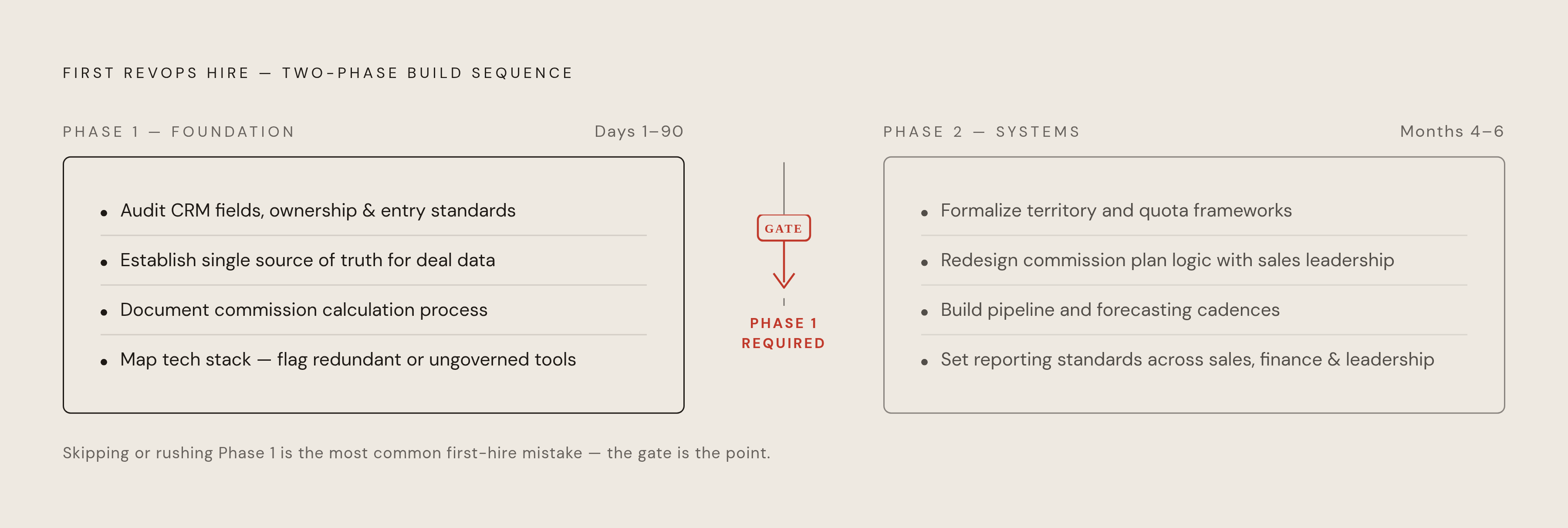
Everything downstream of the data is only as good as the data itself, so CRM hygiene is the prerequisite that makes the rest of the list possible. Fix the data source first. Document what's actually happening in current processes. Identify which broken workflows cost the most, in dollars or in trust. Only then does it make sense to build structured, repeatable systems on top of that foundation.
In the first 90 days, the work concentrates there: auditing CRM fields, ownership rules, and entry standards; establishing one source of truth for deal data; documenting the current commission calculation process even if it's fully manual; mapping the existing tech stack to flag redundant or ungoverned tools. Somewhere in most companies there's a shadow tool three people use that nobody remembers approving, and finding it is part of the job. The problem usually appears in month one.
Months four through six shift toward process design: formalizing territory and quota frameworks, redesigning commission plan logic with sales leadership, building pipeline and forecasting cadences, and setting reporting standards that sales, finance, and leadership can actually agree on. None of that second tier works if the first tier got skipped or rushed, and that's the mistake most companies actually make. They let the new hire skip straight to dashboards, because dashboards are visible and data hygiene isn't.
Why Commission Management Belongs Near The Top Of That Sequence
Multiple 2026 industry sources, including Fullcast, list commission administration as a core RevOps Manager responsibility. That detail settles an argument that costs companies real money when they get it wrong: commission is RevOps's problem from day one, and treating it as secondary is the single most common misstep in how this role gets built.
The cost of mismanaging commission early doesn't accumulate in a straight line. Each pay cycle with errors in it compounds distrust between sales and operations, and distrust, once it sets in, takes far more effort to undo than it would have taken to prevent. A rep who disputes a payout once starts checking every future statement more closely. Do that to the same rep three cycles running, and that rep stops trusting the number entirely, even on the cycles where it's right.
The damage becomes visible in predictable places after that. Reps start running shadow accounting, tracking deals in private spreadsheets because they no longer trust the official figure, and roughly 62% of reps run a parallel spreadsheet like this alongside the official system. Finance can't produce clean accruals or audit-ready records under accounting standards like ASC 606 and ASC 340-40 when the underlying commission math lives in ad hoc spreadsheets. Attrition risk climbs too: survey data indicates that as many as 42% of sellers have left a job over a compensation dispute. A company loses quota-carrying talent over a math problem it could have fixed with better plumbing.
Getting commission right early is a signal as much as an operational outcome. When reps trust their statements, RevOps earns credibility with the sales team, and that credibility unlocks cooperation on every other process the function tries to stand up next. Bungle this step, and every subsequent initiative meets resistance from a sales team that already decided ops doesn't have its act together, a hole that takes far longer to climb out of than the commission math itself took to fix.
What accurate, auditable commission management requires
Ask any commission system whether a rep can calculate estimated commission on a deal currently in progress, in under 60 seconds. If the answer is no, that's a transparency problem, and transparency problems become trust problems fast.
Auditable, in practical terms, means every payout traces back to a specific deal, a specific rate, and a specific rule, with a timestamped record showing what calculation ran, on what data, on what date. Pay periods get locked instead of staying open to retroactive edits, and approvals get logged instead of assumed to have happened.
Accuracy requires its own structural conditions. Deal data needs to flow from the CRM directly into the commission calculation, with no manual re-entry step where a typo or a dropped decimal can quietly slip in. Plan logic needs to handle tiers, accelerators, SPIFs, splits, and clawbacks without someone building a manual workaround every time a plan changes, and plan changes themselves need to live as structured rules rather than get rebuilt as new formulas bolted onto an existing spreadsheet.
There's a finance-specific wrinkle RevOps needs to know cold. ASC 606 and ASC 340-40 require that incremental costs of obtaining a contract, meaning sales commissions, get capitalized and amortized over the expected benefit period rather than expensed the moment they're paid out. A spreadsheet that aggregates into a single per-rep payout number can't cleanly support that treatment. There's no line item to amortize, just a total, and for any organization under real compliance scrutiny, audit-ready records aren't optional. They're a gate.
Why Spreadsheets Structurally Fail At The Scale RevOps Is Managing
Most revenue teams still run this function on fragile spreadsheets and manual data entry, Most revenue teams still run this function on fragile spreadsheets and manual data entry, and that's not a workflow gap so much as a description of an architecture that was never built for the job.
The failure modes are structural. Formula drift sets in as plans get more complex, because tiers, splits, accelerators, and SPIFs don't encode cleanly into cell logic that survives a plan change. Version conflicts appear the moment more than one person touches the file. Manual entry errors happen at the point of data ingestion, before any formula even runs, and there's no audit trail: no record of which version of the sheet ran, on which date, against which inputs, if a number ever gets questioned.
Any change to the compensation plan, a new accelerator, a territory split, a mid-year SPIF, forces someone to rebuild the spreadsheet logic from scratch. Commission software, by contrast, stores plan rules as structured data that updates without a rebuild. The real cost of the spreadsheet approach appears afterward, in the labor of reconciling it: admin hours, dispute resolution, audit prep, and the shadow accounting reps run in parallel because they've stopped trusting the sheet.
Evaluating commission software as a first RevOps decision
The first RevOps hire is often the person making, or heavily influencing, the decision to buy commission software. Get the framework wrong here, and the company just rebuilds the spreadsheet inside a nicer interface.
A handful of capability questions separate tools that scale from tools that quietly break under pressure. Does the platform pull data directly from Salesforce, HubSpot, or whatever CRM the company already runs, without a manual export step? Can the plan logic handle tiered rates, accelerators, SPIFs, clawbacks, and multi-rep splits without someone building a manual patch on the side? How deep does the audit trail go, meaning does every payout trace to a deal, a rate, and a rule, with a timestamped record of who changed what and when? Do reps see their own earnings and deal-level detail in real time, or only after payroll has already closed the books? Can pay periods be locked so historical numbers stop being editable once approved?
Security matters here in a way that's easy to underweight, because commission data is compensation data, among the most sensitive information a company holds on its own people. Encryption in transit and at rest is table stakes. Tenancy needs to be scoped tightly enough that one customer's data is never reachable from another customer's account, and there should be an explicit policy on whether customer data trains any model.
Pricing structure deserves its own scrutiny, and this is where a lot of companies get burned quietly over a couple of years. Seat-based pricing penalizes a growing team, since every new hire becomes a new line item on top of the compensation the software is supposed to manage. Plan-based pricing, tied to the number of active compensation plans rather than headcount, keeps costs predictable as the team grows. Put the question directly to any vendor during evaluation: how is this priced, and what happens to the bill when the sales team doubles?
The quick wins that prove RevOps is working in year one
Credibility in year one comes from visible, specific fixes. A rep who can finally answer their own commission question in under a minute, without emailing ops and waiting two days, notices that change immediately, and that kind of change spreads across a sales floor by word of mouth faster than any all-hands announcement could.
Reducing commission disputes cycle over cycle is a number that's easy to track and easy to defend to leadership. Fewer disputes doesn't just save ops hours; it signals that reps trust the number they're being shown, which is the entire point of the exercise. Killing off the shadow spreadsheets reps have been quietly running means the official system has finally earned enough trust to replace the unofficial one.
None of these wins require the strategic dashboards or the rebuilt forecasting model that were never realistic in year one anyway. They require getting the foundational plumbing right, clean data, an auditable commission process, and a sales team that has finally learned it doesn't need to double-check ops's math anymore.